How To Choose Cookware: Find The Best Set

Introduction
The best cookware for your kitchen depends on your stove, cooking style, budget, and care habits. A home cook in the United States may need pans that work on gas, electric, glass, or induction ranges. The right set should heat evenly, feel safe to use, match your recipes, and last for years.
You do not need a large cookware set to cook well. A few well-chosen pans often work better than a crowded cabinet full of pieces you rarely use. Start with the pan types you need most, then choose materials and features that fit your daily routine.
Quick Answer: How Do You Choose Cookware?
Choose cookware by checking these seven factors:
- Your cooktop: Induction needs magnetic cookware. Glass-top stoves need flat bottoms.
- The pan material: Stainless steel, cast iron, carbon steel, aluminum, copper, ceramic, and nonstick each behave differently.
- Your main foods: Eggs need low-stick performance. Steak needs strong heat. Sauces may benefit from stainless steel or copper.
- Oven use: Check the safe temperature for the pan, lid, handle, and coating.
- Weight and handling: A pan should feel stable but not too heavy for you to lift safely.
- Care needs: Some pans need seasoning, hand washing, or special tools.
- Your budget: Buy fewer durable pans instead of a large set with pieces you will not use.
A useful basic collection for many U.S. kitchens is a 10- or 12-inch skillet, a 2- to 3-quart saucepan, a 5- to 7-quart Dutch oven or stockpot, and a sheet pan. Add a nonstick skillet if you often cook eggs, fish, pancakes, or delicate foods.
Start With Your Stove and Cooking Habits
Your cooktop is the first filter. A pan that performs well on one range may work poorly on another.
Gas ranges
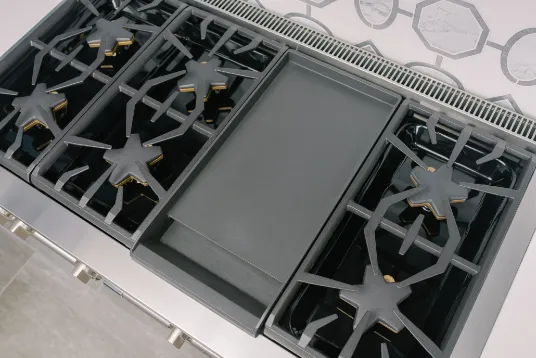
Gas burners heat the pan from below with a flame. They work with most cookware materials, but a pan with a thick, stable base helps spread heat. Thin pans may develop hot spots, especially over a strong burner.
Gas cooking also exposes handles and sides to more heat. Choose handles that stay clear of the flame and do not become dangerously hot during normal use.
Electric and glass-top ranges
Electric burners heat more slowly than gas but retain heat longer. Glass-top ranges need cookware with a flat, smooth base. Rough cast iron can scratch the surface if you drag it. Heavy cookware can also damage a glass cooktop if you drop it.
Lift pans instead of sliding them. Before buying, check that the base sits flat and does not wobble.
Induction ranges
Induction cooktops heat a pan through a magnetic field. The pan must contain a magnetic material, often cast iron or magnetic stainless steel.
A simple home test can help: place a magnet against the bottom of the pan. If it sticks firmly, the pan may work on induction. Still, check the maker’s label because a magnetic base does not guarantee ideal performance.
Induction cookware should also have a flat base that makes good contact with the cooktop. Pans that are badly warped may heat unevenly or fail to work properly.
Your daily cooking
think about what you cook most often:
| Cooking need | Useful cookware |
|---|---|
| Eggs, pancakes, and fish | Nonstick skillet or well-seasoned carbon steel |
| Steak and high-heat browning | Stainless steel, cast iron, or carbon steel |
| Tomato sauce and pan sauces | Stainless steel or enameled cookware |
| Soup and pasta | Large stainless steel pot or Dutch oven |
| Slow braises | Enameled cast iron or heavy stainless steel |
| Stir-frying | Carbon steel wok or skillet with a suitable flat base |
| Baking and roasting | Aluminum sheet pans, stainless roasting pans, or cast iron |
The goal is not to match every food with a different pan. It is to choose a small group of pans that covers your real cooking.
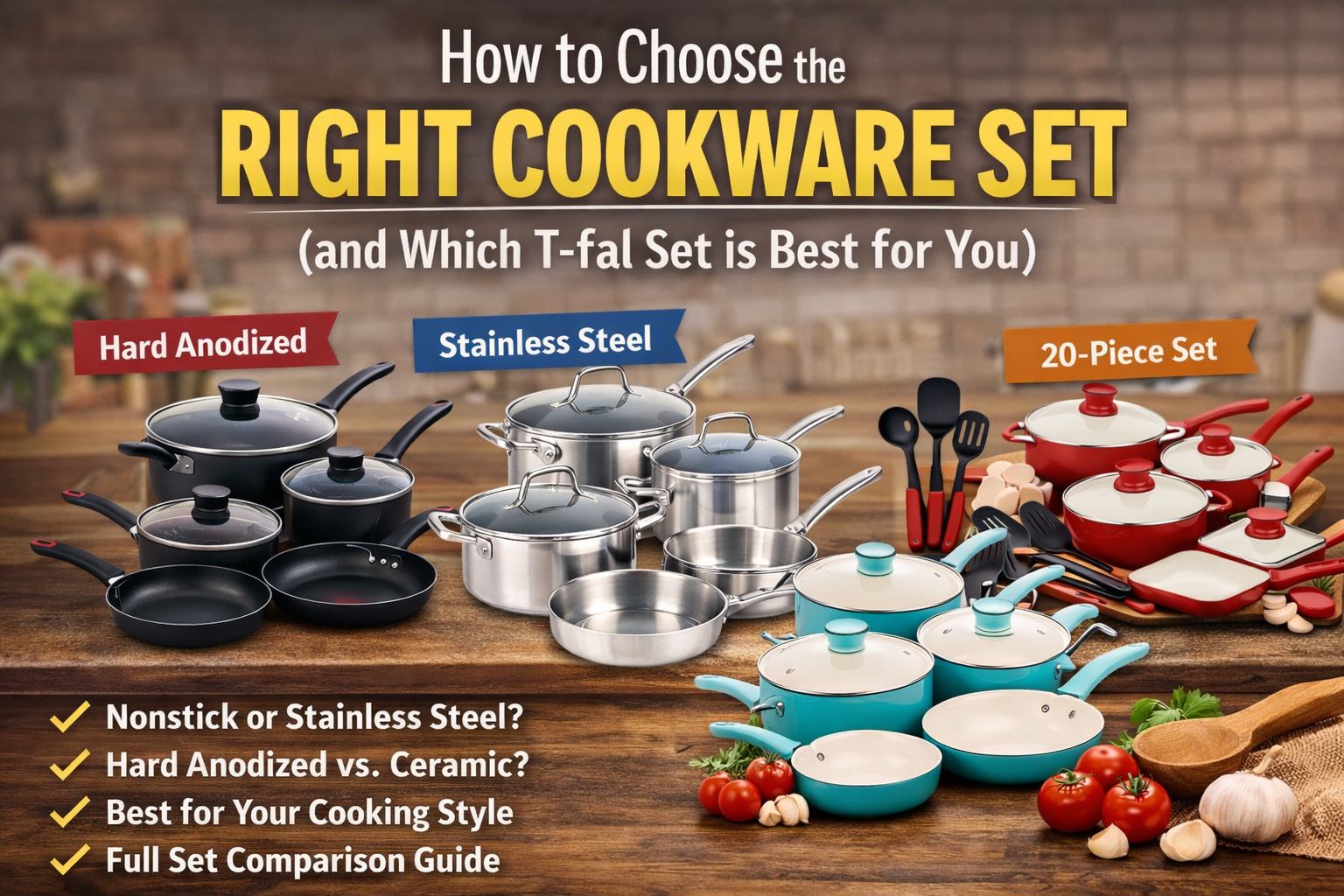
Understand the Main Cookware Materials
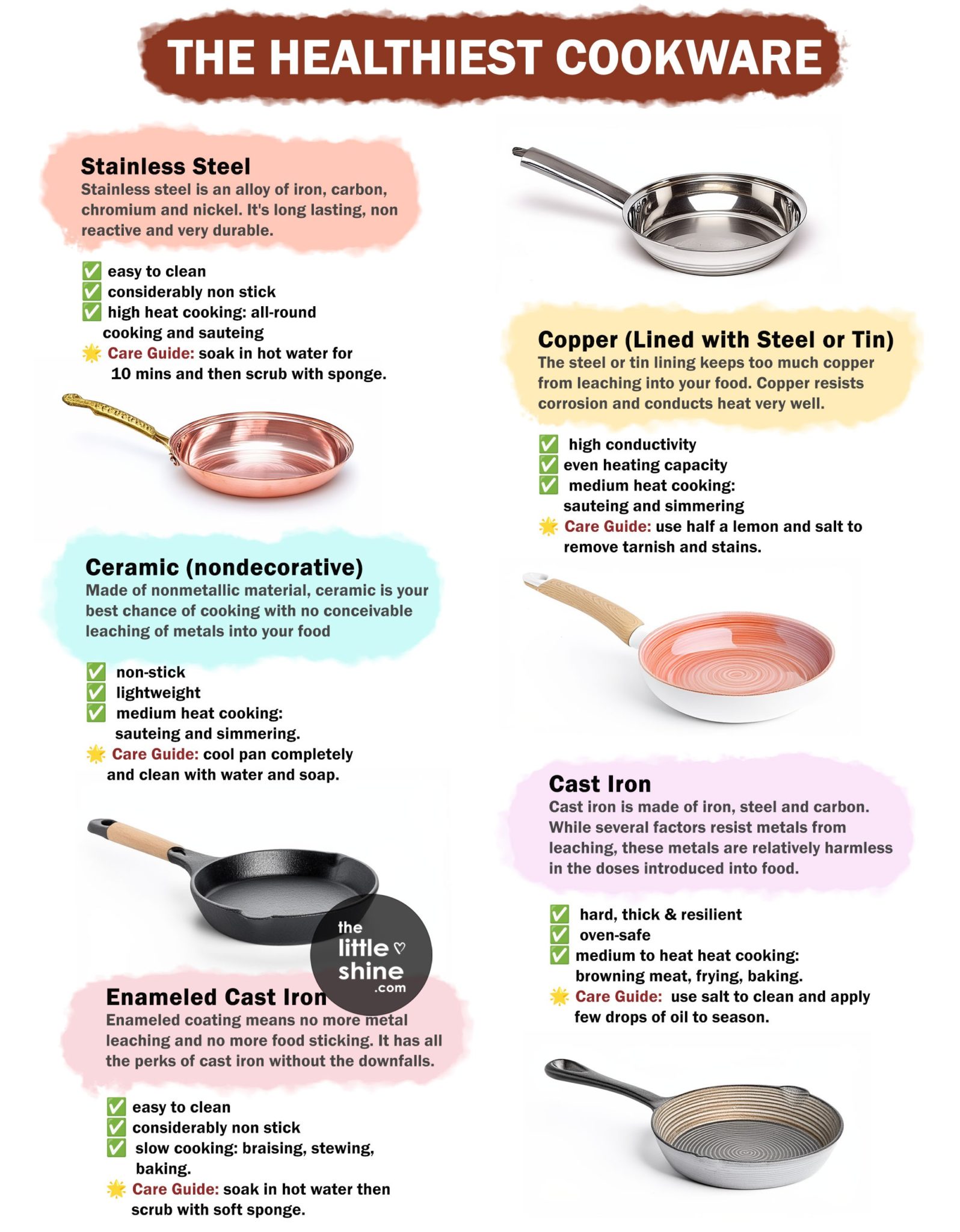
Cookware material affects heat speed, heat control, food release, weight, care, and price. No single material is best for every task.
Stainless steel
Stainless steel is strong, durable, and usually easy to clean. It does not rely on a coating for its cooking surface. Many stainless pans have an aluminum or copper layer inside the base to improve heat spread.
Stainless steel is a good choice for:
- Browning meat
- Deglazing with wine or stock
- Making pan sauces
- Boiling and simmering
- General-purpose cooking
Food may stick if the pan is cold, too dry, or not preheated. To reduce sticking, warm the pan, add oil, and let the food form a crust before turning it.
Some people with a nickel allergy may prefer nickel-free stainless steel or another material. If this applies to you, check the exact alloy and ask a qualified health professional for advice.
Aluminum
Aluminum heats quickly and spreads heat well. It is also light and often costs less than thick stainless steel or copper.
Bare aluminum can react with some acidic or alkaline foods. For that reason, many modern aluminum pans have a nonstick coating, anodized surface, or stainless-steel cooking layer.
Hard-anodized aluminum has a treated surface that is harder than ordinary bare aluminum. It can be a practical middle ground between light weight and durability, but the exact performance depends on the pan’s construction and coating.
Copper
Copper responds quickly to temperature changes and spreads heat well. It is valued for delicate work such as sauces, custards, and sugar cooking.
Most copper cookware has a lining, often stainless steel or tin. Bare copper should not be used for many foods because it can react with food. Copper also needs more care and usually costs more.
Copper cookware may not work on induction unless it has a magnetic plate or base.
Cast iron
Cast iron holds heat for a long time. It is useful for searing, frying, roasting, baking, and cooking on the stovetop.
Traditional cast iron needs seasoning. Seasoning is a layer of baked-on oil that helps protect the iron and improves food release. The surface can change with use and care.
Cast iron is heavy and slow to heat. It can also damage a glass cooktop if dragged or dropped. Acidic foods, such as tomato sauce, may affect a new or weakly seasoned surface and can increase iron transfer into food. A well-seasoned pan is less prone to this problem, but long acidic cooking is often better suited to stainless steel or enameled cookware.
Enameled cast iron
Enameled cast iron combines strong heat retention with a glass-like enamel surface. It is useful for soups, braises, stews, and bread baking.
The enamel does not need seasoning and is less reactive with acidic foods than bare cast iron. However, it can chip if struck or overheated when empty. Check the maker’s instructions before using an enameled pan under a broiler.
Carbon steel
Carbon steel is thinner and lighter than cast iron but can still reach high heat. With seasoning, it offers a naturally smoother cooking surface.
It works well for:
- Eggs after proper seasoning
- Stir-frying
- Searing
- Pancakes
- High-heat stovetop cooking
Like cast iron, carbon steel can rust if left wet. It may also react with acidic foods, especially when the seasoning is new.
Nonstick cookware
Nonstick cookware is useful when you want food to release easily and cleanup to be quick. It is especially helpful for eggs, omelets, fish, pancakes, and foods cooked with little oil.
Many traditional nonstick pans use a PTFE coating. The U.S. Food and Drug Administration evaluates food-contact substances, including substances used in cookware coatings. PTFE cookware is generally intended for normal cooking temperatures, but an empty pan should not be overheated.
Avoid heating a nonstick pan empty over high heat. Follow the manufacturer’s temperature limits, use ventilation, and replace the pan if the surface is badly damaged or peeling. Do not use metal tools unless the maker says they are safe.
“Ceramic nonstick” usually means a sol-gel coating rather than a solid ceramic pan. It may offer easy release at first, but performance can decline with high heat, abrasive cleaning, and repeated use. Read the care instructions instead of assuming every ceramic-coated pan behaves the same way.

Compare Cookware Construction, Not Just the Material
The material name alone does not tell you how a pan will perform. Construction often matters just as much.
Look for a thick, even base
A thick base can reduce hot spots and resist warping. Multi-layer pans may place aluminum or copper between layers of stainless steel. This design can spread heat while keeping a durable cooking surface.
A very thick pan may heat more slowly but hold heat well. A thin pan may respond quickly but create uneven temperatures. Choose based on the task.
Check the cooking surface
Ask these questions:
- Is the surface bare, coated, seasoned, or enameled?
- Can you use metal utensils?
- Is it safe in the oven?
- Does it work with induction?
- Can it go in the dishwasher?
- Does the surface need seasoning or special care?
A pan with a durable surface may be a better long-term choice than one with a long list of features but delicate care needs.
Inspect the handle
A good handle should feel secure, stable, and comfortable. It should give you enough room to grip the pan without touching hot metal.
For oven use, check whether the handle is oven-safe. Silicone, wood, plastic, removable sleeves, and attached rivets may have different limits. The lowest-rated part controls the safe temperature.
A helper handle is useful on large skillets and Dutch ovens. It makes heavy cookware easier to lift with two hands.
Check the lid
A lid should fit well enough to hold steam but should not be difficult to remove. Glass lids let you see the food, while metal lids may tolerate higher heat depending on their construction.
The lid handle and knob also need a temperature rating. Never assume that an oven-safe pan has an oven-safe lid.

Pick the Right Cookware Pieces
A cookware set can look like a good deal, but sets often include small pots or specialty pieces you may rarely use. Build around your most common meals.
The essential four-piece setup
For many U.S. homes, these pieces cover most cooking tasks:
- 10- or 12-inch skillet: Choose stainless steel, cast iron, carbon steel, or nonstick based on your cooking.
- 2- or 3-quart saucepan: Use it for oatmeal, rice, sauces, vegetables, and reheating.
- 5- to 7-quart pot or Dutch oven: Use it for soup, pasta, chili, braises, and batch cooking.
- Half-sheet pan: Use it for roasting vegetables, baking, and one-pan meals.
A 12-inch skillet gives more room for browning, but it may feel heavy and need a larger burner. A 10-inch skillet is easier to handle and suits smaller portions.
When a cookware set makes sense
A set may suit you if:
- You need several pans at once.
- The pieces match your stove and cooking needs.
- The set does not include many unwanted items.
- Each piece has a useful size.
- Replacement lids or parts are available.
- The care rules are consistent across the set.
Compare the pieces one by one. A set is not a bargain if you pay for cookware that stays in the box.
When individual pieces are better
Buy open stock when your needs are specific. For example, you might want a stainless saucepan, a nonstick egg pan, and a cast-iron skillet. This mixed approach often gives better results than choosing one material for every dish.

Use This Cookware Decision Guide
Follow this sequence before you buy.
Step 1: Confirm cooktop compatibility
Check whether you use gas, electric, glass, induction, or more than one type of stove. If you may move to an induction range, choose induction-compatible cookware now or plan for a future replacement.
Step 2: List your three most common meals
Write down what you cook in a normal week. This reveals whether you need a nonstick skillet, a large pot, a sauté pan, or an oven-safe braiser.
Step 3: Choose the surface based on the job
Use this simple guide:
- Choose nonstick for easy release and low-fat cooking.
- Choose stainless steel for browning, sauces, and general use.
- Choose cast iron for high heat and strong heat retention.
- Choose carbon steel for a lighter seasoned pan.
- Choose enameled cast iron for acidic braises and slow cooking.
- Choose copper when fast heat control is worth the cost and care.
Step 4: Check size and weight
A pan should hold the amount of food you usually cook without crowding. Crowding can cause steaming instead of browning.
At the same time, you must be able to lift the pan safely. A heavy pan that stays in the cabinet is not a useful purchase.
Step 5: Read the care and safety instructions
Look for the following information:
- Maximum oven temperature
- Broiler use
- Dishwasher guidance
- Utensil restrictions
- Induction compatibility
- Preheating limits
- Warranty terms
- Replacement lid or handle availability
If the maker does not clearly state a key safety limit, choose a product with clearer documentation.
Step 6: Buy the smallest useful collection
Start with one skillet, one saucepan, and one large pot. Add pieces only when a real cooking need appears.

Cookware Safety and Care Rules
Safe cookware use depends on both the pan and the way you use it.
Do not overheat an empty coated pan
An empty nonstick pan can heat very fast. Use low or medium heat unless the instructions allow more. Turn on ventilation when cooking at higher temperatures.
Birds are especially sensitive to fumes from severely overheated nonstick coatings. Keep pet birds away from the kitchen and follow the coating manufacturer’s safety instructions.
Use the right heat for the pan
Avoid sudden temperature changes. Do not pour cold water into a very hot pan unless the manufacturer says it is safe. Thermal shock can warp metal or damage enamel.
Do not preheat an empty enameled pan for a long time. Use the heat level recommended in the care guide.
Prevent burns
Use dry oven mitts. Wet fabric can transfer heat quickly. Assume metal handles are hot unless the pan has a clear heat-resistant design.
Turn handles inward so children and adults do not catch them while walking past the stove.
Clean according to the surface
- Nonstick: Use soft tools and mild soap. Avoid abrasive pads.
- Stainless steel: Soak stuck food and use a suitable cleaner if needed.
- Cast iron: Dry it fully and apply a thin layer of oil when required.
- Carbon steel: Dry promptly and protect it from rust.
- Enameled cookware: Avoid metal tools and harsh impact.
- Copper: Follow the lining and polishing instructions.
Dishwasher safety does not always mean dishwasher durability. Repeated detergent, heat, and drying cycles can dull surfaces, damage seasoning, or shorten the life of some coatings.
Common Cookware Buying Mistakes
Buying a full set without checking the pieces
A large box can hide poor size choices. Count the pans you will use each month, not the pans shown in the photo.
Choosing by material alone
“Stainless steel” can describe a thin pan or a well-built multi-layer pan. “Ceramic” can describe solid ceramic, enamel, or a ceramic-based nonstick coating. Read the construction details.
Ignoring the handle
A pan may cook well but remain awkward or unsafe if the handle is loose, too short, too hot, or difficult to grip.
Using one pan for every task
A nonstick pan is not ideal for very high-heat searing. Bare cast iron is not always the best choice for long acidic sauces. Matching the surface to the food improves results and extends pan life.
Assuming oven-safe means broiler-safe
Broiler heat is intense and comes from above. A pan may be oven-safe but not safe under a broiler. Check the exact instructions.
Forgetting storage space
Large cookware needs room. Stacking coated pans without protection can damage them. Before buying, decide where the pans will go and how you will lift them out.

Best Cookware Choices by Cooking Goal
| If you want to… | Start with… | Main trade-off |
|---|---|---|
| Cook eggs with little sticking | Nonstick skillet | Coating needs careful heat and utensil use |
| Sear meat | Stainless steel or cast iron | Food may need proper preheating to prevent sticking |
| Make quick sauces | Stainless steel or copper-lined pan | Stainless needs technique; copper costs more |
| Cook soup for a crowd | Large stainless pot or Dutch oven | Larger pots need more storage |
| Bake and roast | Cast iron or sturdy sheet pans | Cast iron is heavy; sheet pans may warp if thin |
| Use induction | Magnetic stainless steel, cast iron, or carbon steel | Some cookware will not work |
| Avoid heavy cookware | Aluminum or lighter stainless steel | Lightweight pans may hold less heat |
| Minimize cleanup | Nonstick or dishwasher-friendly stainless | Easy-clean coatings can wear over time |
The best choice is the one that fits the food, stove, and care routine you will actually use.
Frequently Asked Questions
Is stainless steel or nonstick cookware better?
Neither is better for every task. Stainless steel is durable and useful for browning, sauces, and high-heat cooking. Nonstick is easier for eggs, fish, pancakes, and low-oil cooking. Many kitchens benefit from having both.
What cookware is safest for an induction stove?
Use cookware labeled for induction or test the base with a magnet. Cast iron and magnetic stainless steel usually work. Aluminum, copper, glass, and ordinary ceramic cookware will not work unless they have a magnetic layer.
How many pots and pans does a home cook need?
Many home cooks can cover daily meals with four main pieces: a 10- or 12-inch skillet, a 2- or 3-quart saucepan, a large pot or Dutch oven, and a sheet pan. Add specialty pieces only when your meals require them.
Is scratched nonstick cookware safe to use?
A small surface mark does not automatically tell you the full condition of a pan. However, a badly worn, peeling, or flaking coating can affect cooking performance and may expose the underlying material. Follow the manufacturer’s replacement guidance and replace cookware that is visibly deteriorated.
Can cast iron be used on a glass-top stove?
It can be used with care if the cooktop and cookware maker allow it. Do not slide the pan, drop it, or use a badly rough or warped base. Lift it gently to prevent scratches and impact damage.
Key Takeaways
- Choose cookware for your stove first, especially if you use induction.
- Match the pan surface to the food you cook most.
- Check construction, handle design, lid limits, and oven ratings.
- Buy a few useful pieces instead of a large set you will not use.
- Use nonstick pans with moderate heat and suitable tools.
- Care for cast iron and carbon steel by keeping them dry and protected.
- Replace cookware when coatings are badly damaged, handles are loose, or the base is warped.
- Start with a skillet, saucepan, large pot, and sheet pan, then build from there.
Conclusion
Choosing cookware is less about finding one “best” material and more about finding the right match for your kitchen. Check your stove, cooking habits, space, budget, and comfort with care.
For most U.S. home cooks, a mixed collection works well: stainless steel for general cooking, nonstick for delicate foods, and cast iron or carbon steel for high heat. Buy slowly, read the care instructions, and choose pans you can lift, clean, and use with confidence.