PFOA vs PTFE In Cookware: Explained Simply 2026

I remember standing in the cookware aisle last week holding a new frying pan. The box had a big sticker that said “PFOA Free.” Then I flipped it over and saw “PTFE” listed on the label. PFOA vs PTFE in cookware — the names looked almost the same. I felt confused. Are they the same thing?
This question comes up all the time. I dug into the science and the history so you don’t have to. The short answer is simple. The longer one is useful if you want to buy, use, or replace cookware with confidence.
The One-Sentence Answer You Need First
Here is the main thing to know: PTFE is the nonstick coating on your pan; PFOA was a chemical used in its manufacturing, but it is not used anymore in modern cookware.
Think of it like baking a cake. PTFE is the cake you eat. PFOA was a helper in the mixing pan. It helped make the cake but you would not want to eat that helper. And these days, modern pans are made without it.
PTFE (Polytetrafluoroethylene): The Coating on Your Pan
So what is PTFE? It is the actual slick surface on the pan. It is what gives you nonstick performance.
- What it is: A very slick polymer (a kind of plastic).
- Brand name: You probably know it as Teflon.
- Why it works: The surface is extremely smooth, so food cannot cling to it.
PTFE is the finished coating. When you buy a nonstick pan, you are buying one coated with PTFE. It is safe to handle. It is safe to cook on at normal temperatures when used correctly.
PFOA (Perfluorooctanoic Acid): The Manufacturing Chemical
PFOA is different. It is not the coating itself. It was a processing aid used in factories to help make PTFE.
- What it was: A liquid chemical used as an emulsifier in production.
- The problem: High exposure harmed workers and contaminated nearby water.
- The timeline: Companies agreed to cut use in 2006 and largely eliminated it by 2015.
If you buy a pan today, PFOA was almost certainly not used to make it. It has been phased out of mainstream cookware manufacturing.
Why Everyone Confuses Them
The names look and sound similar. Both belong to the large PFAS family. That overlap makes people mix them up.
Marketing made it worse. Labels that shout “No PFOA” reassure shoppers, but they can also imply that PFOA is still common in other pans. Old news plays a role too. The DuPont contamination scandal involving PFOA got huge media attention. That left a lasting fear of any “P” and “F” chemicals.
How PFOA and PTFE Actually Relate
Let me explain how the two worked together in manufacturing. I’ll keep the science simple and practical.
The Manufacturing Process: Where PFOA Came In
Making PTFE is tricky. PTFE particles do not mix well with water. Think of trying to mix oil and water.
Factories used PFOA like a soap. It helped disperse and bind the polymer particles during production. This made the polymer chains form properly. Once the PTFE formed, the role of PFOA was over.
The Contamination Problem: Why PFOA Was Found in Cookware
You might wonder: “If PFOA was just a helper, why was it in finished pans?”
Good question. The old process was not flawless.
- Leftovers: Tiny traces of PFOA sometimes remained in the mix.
- Heat: Pans were baked at high temperatures to remove residues.
- The error: Sometimes the bake step or the formulation was off. Residual PFOA stayed behind.
Those tiny amounts could off-gas during cooking. That was the real issue. The modern process no longer uses PFOA, so this is much less of a concern in new cookware.
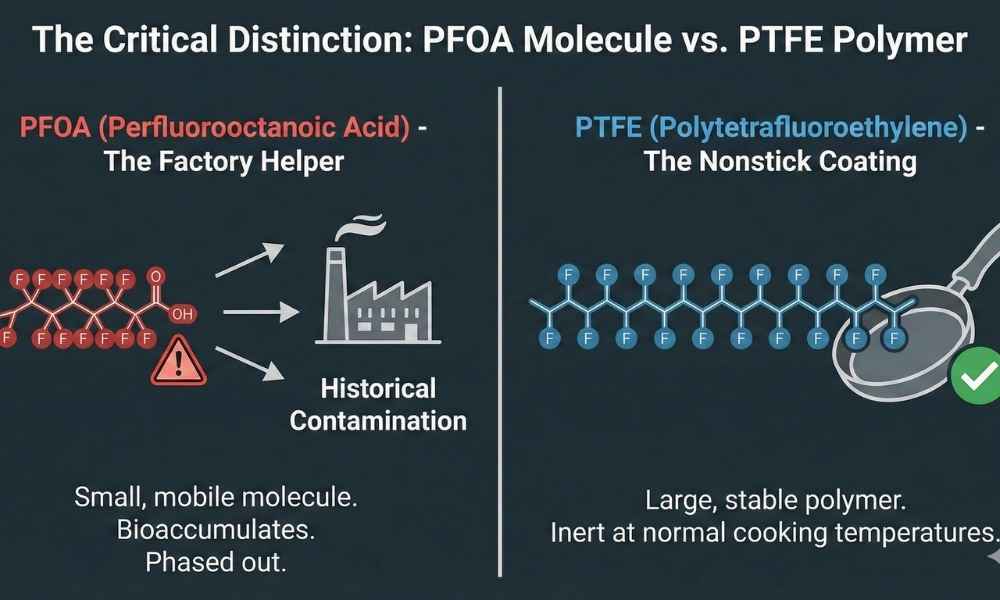
Chemical Structure Comparison: Why Safety Profiles Differ
Size and structure matter. That explains why PTFE and PFOA behave very differently in the body and environment.
- PTFE is large. It’s a long polymer chain. Think of a long, tangled rope. It’s chemically stable and too big for the body to absorb.
- PFOA is small. It’s a single small molecule. It can move through tissues and enter the bloodstream.
Because PFOA is small, it can build up in blood and organs. That caused the health concerns. PTFE, by contrast, is inert and won’t be absorbed if you accidentally ingest a flake.
The Replacement Chemicals: What’s Used Now Instead of PFOA
After PFOA was phased out, manufacturers switched to other processing aids. One common alternative is GenX. These newer PFAS have shorter chains.
- Why the switch? Shorter-chain PFAS clear from the body faster than PFOA and tend to bioaccumulate less.
- The concern: Long-term safety data is incomplete. Some scientists call this a “regrettable substitution.” We replaced one chemical with others we are still studying.
For now, these replacements appear safer than PFOA in many uses. But monitoring and research are ongoing.
Which One Should You Worry About?
Let’s cut to the chase. Is your cookware a health risk? The answer depends on use, age, and condition.
PFOA Health Concerns: The Evidence That Led to Phase-Out
PFOA is clearly harmful at high levels. We learned this from worker and community studies.
Those who were harmed had heavy exposure. They worked with the raw chemical daily or lived near contaminated sites.
High exposure has been linked to:
- Kidney cancer
- Testicular cancer
- Thyroid disease
- High cholesterol
This is serious. But it applies to high, chronic exposure. Cooking on a modern pan once a week is not the same as years of factory exposure.
PTFE Safety Profile: What Decades of Research Show
Is the PTFE coating itself safe? Yes—when used as intended.
If you accidentally swallow a small flake, it is inert. It will pass through your digestive tract. It does not break down into toxic fragments in your gut.
- Ingestion: Flakes are inert and pass through the body.
- Overheating: The main risk is heating a dry PTFE pan above about 500°F (260°C). The coating can degrade and release fumes. Those fumes can cause flu-like symptoms known as polymer fume fever.
Use medium heat and avoid dry, empty pans to stay safe.
Why Cookware PFOA Risk Was Overblown
We used to point fingers at pans. But data shows cookware was a small source of PFOA exposure for most people.
Major PFOA sources were:
- Contaminated drinking water near factories
- Food packaging like microwave popcorn bags and grease-proof wrappers
- Stain-resistant treatments on carpets and furniture
By comparison, pans contributed little. The real exposure risk came from industrial pollution and consumer products, not your home skillet.
Post-2015 Cookware: The PFOA Presence Reality
If you buy a pan today, you can relax more than in the past.
Independent labs now test pans for PFOA and other PFAS. Pans made after 2015 rarely show measurable PFOA.
- The standard: Major brands follow strict manufacturing practices.
- The result: Modern nonstick pans are effectively PFOA-free.
So the “old” chemical is very unlikely to be in a new pan.
Timeline and Regulation: When Things Changed (And Why It Matters)
History helps you judge your cookware. Knowing when a pan was made tells you a lot about its safety.

2006: The Voluntary Phase-Out Agreement
In 2006, the EPA asked eight major companies to reduce PFOA. They launched a stewardship program.
- The deal: Reduce use by 95% by 2010, eliminate it by 2015.
- The catch: It was voluntary, not a federal ban.
Companies complied because public pressure and litigation made it urgent. The result was a wide phase-out in manufacturing for consumer goods.
2013-2015: The Transition Period
Switching industrial processes takes years. Between 2006 and 2013 companies tested alternatives and updated factories. By 2015, the biggest brands had mostly stopped using PFOA in cookware.
What This Means for Your Cookware by Purchase Date
Go check your pans. When did you buy them? The purchase date is helpful.
- Pre-2006: These likely contain PFOA residues. Action: Replace them.
- 2006–2013: This is a gray zone. Some pans may be safe; others not. Action: Consider replacing to be sure.
- 2013–2015: Most major-brand pans were already PFOA-free by now.
- 2015 and later: These are PFOA-free in practice. Action: Keep and use them.
If the pan is scratched or worn, replace it anyway. Wear and tear reduces safety and performance.
Current Regulations and What’s Coming Next
The PFOA story moved from voluntary action to stronger laws in some regions. Regulators are now looking at the whole PFAS class.
- Europe: The EU is proposing tighter restrictions and bans on many PFAS.
- USA: States like Maine and California have passed laws restricting PFAS in cookware and consumer goods.
This could mean broader limits on PTFE-style coatings in the future. For now, PTFE remains the standard nonstick technology for most cook-at-home uses.
The “PFOA-Free” Marketing Claim Decoded
You see “PFOA-Free” on lots of boxes. It sounds reassuring. But the label only tells part of the story.
What Brands Legally Mean by “PFOA-Free”
When a brand says “PFOA-Free,” they mean: “We did not add PFOA to this pan.”
It is a specific, verifiable claim about one chemical. If tested, the pan should have no measurable PFOA. The label does not say what other chemicals were used.
Why the Label Appeared Everywhere After 2015
If PFOA was phased out by 2015, why do we still see the sticker years later? Simple—marketing and consumer anxiety.
- Fear sells: Brands know buyers worry about chemicals.
- Differentiation: Labels help products stand out on crowded shelves.
Be aware: most reputable new nonstick pans are PFOA-free, so the label mostly confirms what should already be true.
The Critical Information These Labels Hide
A “PFOA-Free” label states what is not in the pan. It doesn’t tell you what is in it.
A pan can be “PFOA-Free” and still be:
- Coated in PTFE: A Teflon-style polymer that gives classic nonstick performance.
- Made with other PFAS: Replacements such as GenX or other processing aids.
The sticker is true—but not the whole story. Look for full material disclosures if you want more detail.
Greenwashing vs Genuine Safety Improvements
“Greenwashing” is when packaging makes a product seem eco-friendly without meaningful change.
Watch for pans that use nature imagery or big “Non-Toxic!” claims. Flip the box. If it lists PTFE or “polymer” on the ingredients list, it is still a standard nonstick pan—just with prettier packaging.
- Look for clear material names (PTFE, ceramic sol-gel, cast iron).
- Trust brands that disclose manufacturing details and testing results.
Health Impact Reality: Separating Hype from Evidence
Let’s focus on health. Headlines can be scary. Facts help you act sensibly.
Documented PFOA Health Effects: Who Was Actually Harmed
The harm from PFOA is real and documented. But it was concentrated among people with very high exposure.
- Where: The DuPont plant in West Virginia is a notable case.
- Exposure: Workers inhaled or handled PFOA; local water supplies became contaminated.
- Outcome: Elevated rates of certain cancers and other illnesses.
This is tragic. But it is not the same risk as occasional home cooking on modern pans.
PTFE Health Effects: What Actually Happens with Exposure
Can a pan hurt you? Yes, but only in a specific scenario: overheating a dry PTFE pan.
This can cause polymer fume fever, also called “Teflon flu.”
- How it happens: A dry, empty pan overheats above ~500°F (260°C).
- The reaction: The coating breaks down and releases fumes.
- The symptoms: Flu-like symptoms—fever, chills, headache—for a day or two.
This is uncommon. Avoid leaving an empty nonstick pan on high heat and you are unlikely to experience it.
The Blood Serum Reality: PFOA Detection in General Population
A striking fact: most Americans tested show low levels of PFAS in their blood. That includes PFOA historically.
But the main sources were not pans. They were:
- Stain-resistant carpets and upholstery
- Waterproof clothing
- Food wrappers and grease-proof paper
- Contaminated tap water near industrial sites
Since the phase-out, blood levels of PFOA have been declining. That’s a positive sign that regulation and manufacturing changes worked.
Medical Perspective: Should Your Doctor Be Concerned?
I asked a doctor friend. Her answer was practical: “I don’t ask patients about their pans. I ask about their water.”
For most people, standard cooking is not a medical emergency. If you own pet birds, be careful—birds are unusually sensitive to fumes from overheated PTFE coatings.
Who Should Care More About This Distinction
Most of us can use modern nonstick pans with low worry. Still, some groups should be extra cautious.
Pregnancy and Fetal Development Concerns
If you’re pregnant, you want to reduce avoidable risks. PFOA can affect fetal development at high exposures. So a simple rule helps:
- The Rule: Replace old, scratched, or pre-2013 cookware.
- Why: It’s inexpensive peace of mind while your baby develops.
Children and Cumulative Exposure
Kids are more sensitive to chemicals because of their size and development. Reducing lifetime exposures is wise.
- Strategy: Teach kids to cook on medium heat.
- Safety: Don’t let them leave pans unattended on high heat.
Individuals with Compromised Immune Systems
People with weakened immune systems may want to lower any avoidable chemical stress. PFOA has been linked to lower vaccine response in heavy exposures.
If you’re concerned, switching to ceramic, cast iron, or stainless steel is a low-cost step that can reduce worry.
Making Sense of Your Existing Cookware
Open your kitchen cabinet. Let’s sort your pans by age and condition. I’ll walk you through what matters and what to do.
Dating Your Nonstick Cookware: Manufacturing Era Assessment
How old is that skillet? A few ways to find out:
- Look for a stamp: The bottom may have a date code or serial.
- Check the receipt: Search your email for the order or date.
- Estimate: If you think you bought it before 2013, treat it as older and consider replacement.
If you don’t know the date and it looks worn, it’s often best to replace it.
Pre-2013 Cookware: Should You Replace It?
Yes.
Why replace older pans?
- Risk: Older pans may contain PFOA residues.
- Age: Nonstick coatings typically last 3–5 years under normal use.
- Cost: A safe new pan often costs $20–$40. That’s a small investment for better safety and performance.
The Scratched and Damaged Assessment
I see pans that look like they went to war. Flaking, deep scratches, gray residue—time to toss them.

Throw it out.
- Chemicals: Deep scratches can expose layers and release more compounds.
- Bacteria: Food traps in cracks and crevices.
- Performance: It no longer behaves as a nonstick pan.
Don’t feel guilty. Pans are tools. They wear out and deserve replacement when performance or safety drops.
Safe Use Protocols for Keeping What You Have
If your pan is post-2015 and still smooth, keep it. Use it in ways that minimize risk.
- Keep it cool: Cook on low to medium heat for most foods.
- Use oil: Never heat an empty nonstick pan. Add oil or butter before turning on the burner.
- Ventilate: Use your stove fan or open a window while cooking.
- Soft tools: Use silicone or wooden utensils. Avoid metal that can scratch the surface.
Nonstick Alternatives: How PFOA and PTFE Concerns Compare
If you want to avoid PTFE and PFAS entirely, there are solid alternatives. Each has pros and cons for performance and safety.

Ceramic Nonstick: The PFOA/PTFE-Free Alternative
Ceramic nonstick coatings are popular as a PTFE-free choice. They use a sol-gel silica base that feels slick at first.
- What it is: Silica-based sol-gel coating (derived from sand).
- The good: No PTFE, no PFOA.
- The bad: The coating wears faster than PTFE—often within a year for cheap brands.
- The catch: Low-quality ceramic pans may include other additives. Stick with reputable makers and check reviews.
Cast Iron and Carbon Steel: The “Natural” Nonstick
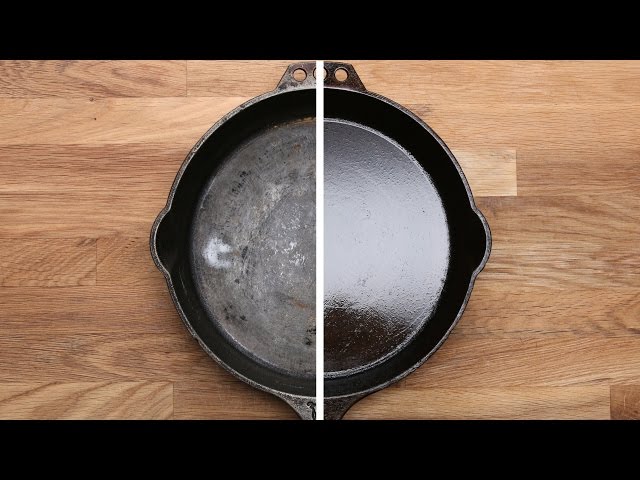
Cast iron and carbon steel develop a natural nonstick layer through seasoning (baking oil onto the metal). They are durable and chemical-free when cared for properly.
- How they work: Build up a polymerized oil seasoning layer on the metal.
- The pros: Extremely durable. No synthetic coatings. A properly seasoned pan performs well.
- The cons: Heavy. Require maintenance to prevent rust. Can leach small amounts of iron—usually harmless and sometimes beneficial.
Stainless Steel: The Chef’s Choice
Stainless steel is common in professional kitchens. It has no coating to peel or off-gas.
- The safety: Pure metal with no synthetic coating.
- The trade-off: Food can stick without fat and correct technique.
- My advice: Use stainless for searing, browning, and high-heat cooking. Use a safe nonstick for eggs and delicate items.
The Future of Nonstick: Beyond PFOA and PTFE
The cookware world is changing. We’re seeing new materials and rising regulation.
Next-Generation Tech
Researchers are exploring plant-based and bio-derived coatings. Imagine nonstick layers made from polymerized vegetable oils or beeswax derivatives. These ideas are promising but not yet mainstream for long-lived cookware.
The Regulatory Pressure
Regulators worldwide are tightening PFAS rules.
- Total Bans: Some regions are pushing to ban entire classes of PFAS, which could include PTFE.
- The result: In a few years, Teflon-style pans may be less common or reformulated significantly.
Expert Perspectives: What Scientists and Doctors Actually Say
I read the papers and talked to experts so you don’t have to. Here’s the consensus in plain language.
Toxicologist Viewpoint
A toxicologist will tell you: “The dose makes the poison.” Small, occasional exposures to PTFE or to residual PFAS in modern pans are usually negligible. They worry more about contaminated water, industrial exposure, and PFAS in consumer goods like carpets.
Environmental Chemist Perspective
Environmental chemists look at the lifecycle. They say: “The pan is likely safe for you, but PTFE is a problem for the planet.” PTFE does not break down easily. When thrown away, PTFE-lined products can persist in landfills and enter the environment.
Choosing Cookware Based on PFOA/PTFE Understanding
Let’s make this practical. Ask yourself three quick questions to pick the right cookware.
1. When was your pan made?
- Before 2013: Replace it.
- After 2015: It’s probably PFOA-free—keep it if it’s in good shape.
2. How do you cook?
- High heat (searing steak): Use cast iron or stainless steel.
- Low heat (eggs/pancakes): A PTFE pan or ceramic nonstick works well.
3. Who are you feeding?
- Birds or tiny pets: No PTFE. Ever.
- Pregnant or immune-compromised: Choose ceramic, cast iron, or stainless for peace of mind.
Frequently Asked Questions
“If PFOA is gone, why do people still worry about Teflon?”
Old fears die slowly. The “forever chemical” label stuck. People lump PTFE (the coating) together with PFOA (the former processing aid). That creates lasting worry.
“Can PFOA-free cookware still have PFOA in it?”
Technically, trace amounts might exist in some older stock or very rare cases. But for post-2015 cookware from reputable brands, PFOA is effectively gone—comparable to finding a grain of sand in a large pool.
“Is PTFE the same as PFAS?”
Yes and no. PFAS is a large chemical family. PTFE is chemically a fluoropolymer and falls under the PFAS umbrella in some classifications. But PTFE behaves very differently from small PFAS like PFOA. PTFE is a stable polymer used as a coating, while PFOA was a small, mobile molecule of concern.
The Bottom Line: Making Peace with Imperfect Information
We live surrounded by chemicals. It’s not possible to avoid everything. But we can make smart, low-cost choices.
Here is what we know for sure:
- PFOA is gone from mainstream cookware production since the phase-out.
- PTFE is safe for normal home cooking when you don’t overheat it.
- Old and damaged pans are the real risk.
What you should do today:
Check your cookware. Toss scratched or pre-2013 pans. Keep modern pans and use them on low to medium heat. Then, cook a healthy meal. Eating real food at home is one of the best things you can do for your health—far more important than pan coating debates.
Cookware Materials Comparison
| Material | Nonstick Performance | Lifespan | Chemical Safety Profile | Best Used For | Care & Maintenance |
| PTFE (Traditional Nonstick) | Excellent (Nothing sticks) | Low (3–5 years) | PFOA-free since 2015. Contains PTFE. Safe up to 500°F. | Delicate foods: Eggs, fish, pancakes, sticky sauces. | Hand wash only. Soft tools (silicone/wood). Never overheat. |
| Ceramic (Sol-Gel) | Good (Initially very slick, fades fast) | Very Low (1–3 years) | PFOA & PTFE-free. Silica-based. “Green” option. | Low-heat cooking. Eggs and simple sautés. | Hand wash. Very brittle—can chip if banged. |
| Stainless Steel | Low (Food will stick without oil/skill) | Forever (Indestructible) | No coatings. Inert. Trace nickel/chromium (safe for most). | Searing meat, browning, acidic sauces (tomato/wine), boiling. | Dishwasher safe. Can scrub with steel wool. Requires pre-heating. |
| Cast Iron | Variable (Gets better with age/seasoning) | Forever (Heirloom quality) | No synthetic chemicals. Leaches small amounts of dietary iron. | High-heat searing, baking, camping, steak. | Hand wash (no soap or little soap). Must dry immediately & oil. Heavy. |
| Carbon Steel | Variable (Like cast iron, but lighter) | Forever (Durable) | No synthetic chemicals. Natural oil polymerization. | Wok cooking, high heat, restaurant-style searing. | Same as Cast Iron. Requires “seasoning” to maintain surface. |
Quick Action Checklist: What to Do Right Now
- Check pan dates or receipts. Replace pans bought before 2013.
- Discard pans with deep scratches, flaking, or gray residue.
- Use medium heat and add oil before heating nonstick pans.
- Ventilate your kitchen while cooking. Turn on the hood or open a window.
- Consider stainless, cast iron, or high-quality ceramic if you want to avoid PTFE.
How to Spot and Test Old Cookware
If you want to be sure about an older pan:
- Look for manufacturer stamps or model numbers and search online for production years.
- Contact the brand with the serial/model number to confirm the manufacturing date.
- Professional labs can test for PFAS, but that’s costly and usually unnecessary for household pans.
If you want help picking a safe replacement, I can suggest models and price ranges for different budgets and cooking styles.