Who Owns Your Cookware? A Guide to Brands and Parent Companies

I used to think the logo on a pan told the whole story. I was wrong. Most cookware brands are actually owned by huge parent companies. Cookware ownership matters because the parent company decides where the pot is made, the quality of materials, and the price you pay.
This ownership changes everything about the product. It affects the warranty support you get when things break. It also dictates how strict the quality control is. Often, the name on the pan is just a label. The real owner is a giant group behind the scenes.
Knowing the real owner helps you shop smarter. It stops you from paying extra for a fancy brand name. You can judge the pan by who actually makes it. Let’s dig into what ownership really means for your kitchen. I’ll share tips from my own testing and buying habits, and explain how ownership links to manufacturing, materials, warranty, and long-term value.
Also read :BK Cookware Explained for Beginners
2. What Does “Owning a Cookware Company” Mean?
To understand this, think of a family tree. Owning a cookware company means holding the rights to the brand name, but not always the factory. A parent company is the boss at the top. They pay the bills and set the rules. The brand is the face you see in the store.
It is vital to know the difference between a brand and a maker. The brand is the logo on the box. The manufacturer is the factory that actually shapes the metal. Many brands do not build their own stuff. They pay other factories to make it for them. This is common with stainless steel, cast iron, nonstick, and carbon steel lines.
Big companies often collect brands like trading cards. One group might own five different cookware names. They might design a pan in France but build it in Asia. This helps them sell to all kinds of cooks. It keeps costs low and profits high. When you know who owns a brand, you learn more about likely sourcing, quality control standards, and warranty policies.
3. Independent Cookware Brands vs Corporate-Owned Brands
There are two main players in this game. You have the small shops and the giant groups. Let’s see how they compare for your kitchen. I’ll focus on what matters to cooks: build quality, materials, customer service, and price.
3.1 Independent or Family-Owned Cookware Brands
I have a soft spot for the little guys. Independent brands usually focus on one product type and care deeply about their history. They often treat their pots like art. This means you get a tool that feels unique and often uses carefully chosen materials like heavy-gauge stainless steel, forged aluminum, or hand-finished cast iron.
But staying small is hard work. It costs more to run a dedicated factory. This means you will likely pay more at the store. Also, being independent does not guarantee the best pan. Small brands can struggle with scaling, quality control, and after-sale support. I’ve seen beautiful pans that ship with uneven heat distribution because the factory can’t test every piece.
3.2 Cookware Brands Owned by Large Companies
Then you have the household names. Large companies buy multiple brands to share factories and cut down on costs. They own many names to sell to everyone. One company might own the pan you buy and the one your mom buys. These firms often manage global supply chains, bulk sourcing, and centralized quality control.

This size can be a big plus. It lets them lower prices through shared logistics, joint R&D, and mass production. They use the same ships and teams. This makes good gear cheaper for most of us. At the same time, corporate brands can invest in new coatings, better stainless grades, and larger warranty programs.
4. Who Owns Popular Cookware Brands?
I was shocked when I first saw this list. It changes how you see the store shelves. A few huge groups own most of the famous cookware names you know. It is rare to find a truly solo act these days.
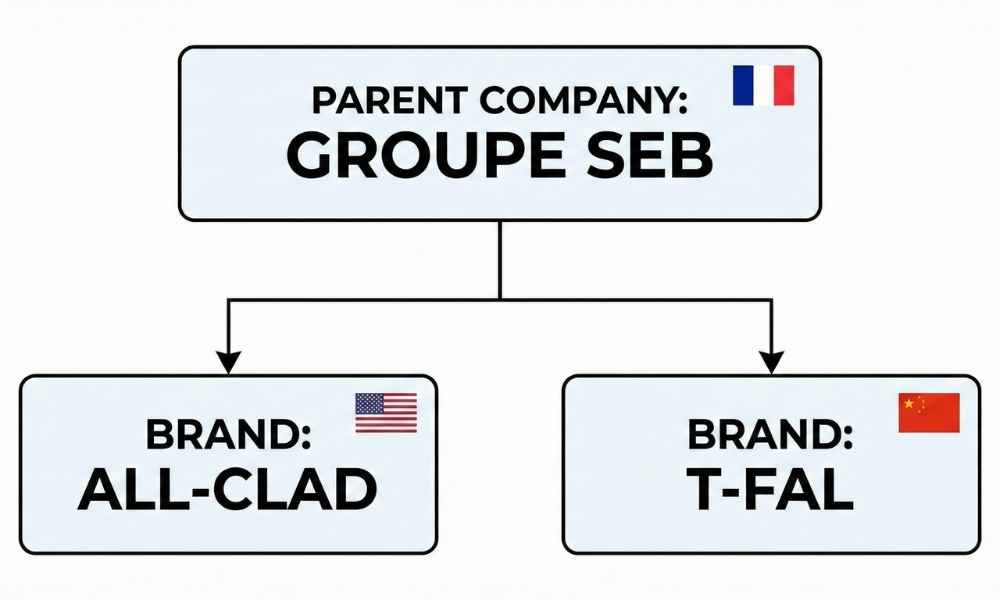
Here is a quick look at who owns what. This list helps you see the connections. I include notes on manufacturing origin and the brand’s market position where useful.
| Brand Name | Owned By | Quick Note |
| All-Clad | Groupe SEB | Made in USA, owned by a French giant. |
| T-fal | Groupe SEB | Budget friendly, same owner as All-Clad. |
| Le Creuset | Private / Family | Still mostly independent and focused. |
| Calphalon | Newell Brands | Owned by a huge US consumer goods group. |
| Cuisinart | Conair Corp | Yes, the same company that makes hair dryers. |
| Staub | Zwilling Group | A knife company owns this iron pot brand. |
| Lodge | Lodge Family | Still family-owned and made in the USA. |
You can see the pattern here. Big groups often mix high-end and budget brands. Knowing the owner tells you if a brand is a solo expert or part of a big team. It helps you judge the price better and anticipate where the cookware might be manufactured or serviced.
5. Does Ownership Affect Cookware Quality?
I used to think big companies ruined good brands. That is not always true. Ownership does not set quality on its own; materials and factory rules matter most. You can have a great pan from a huge group. You can also buy a dud from a small shop.
Quality comes from the metal, not the owner. A good parent company will spend cash to buy the best steel and run tough tests. They want you to keep buying their stuff. So, they often keep the quality high to protect the brand name. That means better stainless grades, improved nonstick coatings, and stricter flatness and heat-distribution checks.
Do not judge a pan just by its parent. Some big corporate brands make the best gear in the world. Look at how the pan cooks, how evenly it heats, and how long it lasts. That tells you the real truth. The name on the contract matters less than the food on the plate.
6. Why Some Cookware Brands Feel “Different” Even Under the Same Owner
It can feel weird when one group owns a cheap brand and a pro one. Why do they feel so different in your hand? Parent companies keep brands distinct to sell to different types of cooks. They want to reach everyone, from the broke student to the master chef.
Think of it like car companies. One maker often has a luxury line and a basic line. Each brand targets a specific budget and cooking skill level. They keep the designs apart on purpose. They do not want the cheap pan to hurt the image of the fancy one. Marketing, packaging, and retail placement all reinforce this separation.
The real change is often deep inside the factory. Two brands can have the same owner but use different metal and workers. The high-end brand gets the best team and materials. The budget brand gets the faster, cheaper production line. It is all about fitting your specific needs, from induction-ready stainless steel to economy nonstick for easy cleanup.
7. Manufacturing vs Ownership
Many home cooks mix up these two things. It is an easy mistake to make. A cookware brand can be owned in one country but made in a totally different one. Just because a brand has a German name does not mean the pan was cast in Germany.
This happens mostly to save money. Companies design products at home but use factories abroad to keep the price down. Specialized factories in Asia often make parts for brands all over the world. This is how they keep shelves full without charging you a fortune. Common manufacturing hubs include China, Vietnam, Thailand, and parts of Eastern Europe for specialized lines.
Global supply chains are complex. A pot might have a handle from one place and a body from another. Do not assume the headquarters is the factory. Always check the box if origin matters to you. Look for labels like “Made in USA,” “Made in France,” or “Assembled in [country]” and check the warranty page for manufacturing and service details.
8. Should You Care Who Owns a Cookware Company?
It is a valid question to ask. Does the owner really change how your eggs cook? You should care about ownership if ethics, warranty support, or manufacturing origin matters to you. For many of us, the pan’s performance is what counts most.
If you care about where your money goes, check the owner. Some people prefer to support small local businesses. Others want the safety of a big corporate warranty. Big companies often have better customer service teams to help you out. They have the cash to fix things when they go wrong. On the flip side, independent makers can offer repairable parts, local service, and small-batch quality control.
But do not stress too much over it. Ownership is just one part of the puzzle, not the whole picture. If a pan feels good and cooks well, it is a good pan. Use ownership to tie-break between two similar choices. Focus on what works for your meals: heat source, cooking style, and how much time you want to spend cleaning and maintaining your pans.
9. Common Misconceptions About Cookware Ownership
There is a myth that big companies ruin quality. I hear this all the time. Corporate ownership does not mean the cookware is low quality; many giants maintain high standards. They have the cash to buy better machines. They can afford the best engineers and lab testing for things like nonstick durability and thermal conductivity.
Another trap is looking only at the map. People assume European pots are always the best. “Made in Europe” does not guarantee a better pan than one made in Asia. Factories in Asia are very high-tech now. They often make gear for the top luxury brands and follow strict ISO and safety standards.
We also love the little guys too much. We think small brands are perfect. Independent brands are not always superior; they often face cash struggles that hurt the product. They might lack the funds for strict checks. Do not let the story blind you to the facts. Check reviews, lab tests, and long-term user feedback before deciding.
Final Thoughts – How to Use Ownership Information Wisely
Knowing the owner changes how you shop. It helps you see why prices differ. Understanding ownership helps you spot true value and avoid paying just for a brand name. You can compare pots fairly now. Use ownership info along with material data, manufacturing origin, and real-world tests.
Use this info to set your expectations. If a giant company owns a budget brand, expect decent quality but mass production. Do not let the parent company decide for you; let your cooking style be the guide. Your stove does not care about the logo.
The best pan is the one you love to use. It should fit your hand and your budget. The best cookware is the one that fits your cooking style, budget, and expectations — regardless of who owns the brand. Cook with confidence and enjoy your meal. I test pans on real stoves, and my pick is always the one that makes cooking easier and cleanup faster.

Common Answer For Who Owns Your Cookware
Who owns most cookware brands?
A few giant global groups control the market. Companies like Groupe SEB and Newell Brands own many of the names you see on shelves. These parent companies often manage design, global sourcing, and warranty programs for several brands at once.
Are cookware brands owned by the same companies?
Yes, parent companies often own several brands. This lets them sell both budget and luxury items to different people. They can target students, busy families, and professional chefs without diluting one brand’s image.
Does brand ownership affect quality?
Ownership is just one factor. The quality depends more on the materials used and the strictness of the factory checks. Look at the grade of stainless steel, whether the pan is multilayer (clad), the type of nonstick, and any third-party test results.
Is independent cookware better?
Not always. Independent brands have great stories and focus. However, big corporate brands often have better warranties and lower prices. Independent makers can offer craftsmanship and repair options that large firms may not.
Where are most cookware brands manufactured?
Most cookware is made in Asia to keep costs down. Some high-end lines are still made in the USA or Europe. Check product labels and warranty pages for exact origin, and don’t assume a brand’s country of origin matches its factory location.
10. How to Check Who Really Owns a Brand (New)
If you want to verify ownership, here are simple steps I use when shopping online or in-store:
- Search the brand name + “owner” or “parent company.”
- Check the brand’s official site—look for “About us” and corporate links.
- Read product warranty pages for contact and service details.
- Look up the company on business databases like SEC filings or corporate directories for large groups.
- Check manufacturing labels on the box for “Made in” or “Assembled in.”
These steps tell you whether a brand is independent and where its products are made. Doing this takes a minute and can save you from surprise returns or poor warranty coverage.
11. Quick Buying Checklist (New)
Use this short checklist before buying cookware. I keep it on my phone when I shop:
- Material: stainless, cast iron, nonstick, carbon steel, anodized aluminum.
- Origin: Where was it made or assembled?
- Owner: Independent or corporate parent? (Use the steps above.)
- Warranty: Length and what it covers (coating, warping, handles).
- Reviews: Look for long-term user feedback, not just launch posts.
- Compatibility: Works on your stove type (gas, electric, induction).
- Repairability: Are parts replaceable (lids, handles) or recycled?
This checklist keeps choices practical. It links ownership to the real needs of cooking: performance, durability, and service.
12. Warranty and Service Tips (New)
Warranty and customer service matter. Here’s how to use ownership info to help with repairs and returns:
- If a brand is owned by a large group, check the group’s global service centers and phone support hours.
- Independent brands may offer direct repairs or parts. Ask about turn-around time.
- Keep receipts and serial numbers. Large companies often require proof for warranty claims.
- Register your cookware on the brand site if they offer extended coverage or support.
I once had a warped pan. The corporate-owned brand sent a replacement fast. That experience made me value strong warranty support as much as initial build quality.