Is Teflon toxic when scratched: What You Need to Know Now 2026

The short answer is simple: PTFE (the stuff in Teflon) passes right through you. Your body cannot digest it. It does not get absorbed into your blood. It basically enters your mouth and leaves the other end without doing anything. You do not need to call poison control or rush to the ER. Toxicologists agree that accidentally eating a few tiny flakes is “biologically inert.” That is a fancy way of saying your body ignores it.
What Those Black Flakes Actually Are
When you see those little black specks in your eggs, they are usually one of two things:
- PTFE Fragments: Actual bits of the nonstick coating.
- Carbon Buildup: Burnt food and oil that turned into a crust and flaked off.
Neither of these is a poison. While it feels gross to think about eating “plastic,” the amount you’d get from a scratch is microscopic. We ingest tiny amounts of inert materials all the time (think apple wax or certain food-grade additives). A tiny flake of Teflon behaves the same way in your gut. It’s inert and passes through.
The Real vs Perceived Danger: Science vs Fear
Our fear often comes from old news stories. For years, people worried about a chemical called PFOA. That chemical was used decades ago to help make Teflon, and it was a real concern.
But here’s the catch:
- Since 2013, PFOA is no longer used in Teflon manufacture by major brands.
- Even when PFOA was used, most of it was removed or destroyed during factory processing long before the pan arrived in your kitchen.
The scratch itself isn't the toxic part. The real danger with Teflon is heat—not a scrape. If your pan has a line through it, you are not in immediate danger.
PFOA and PFAS: a quick explainer
PFOA belongs to a larger family called PFAS (per- and polyfluoroalkyl substances). PFAS can persist in the environment, which is why they got attention. Modern nonstick coatings are made to be PFOA-free. Still, PFAS is a useful search term to understand the broader public concern.
Why Scratching Matters Differently Than You Think
To answer “Teflon toxic when scratched,” we need to look at what Teflon actually is. Teflon is a brand name for a plastic called PTFE.
PTFE Chemistry: Why It’s Slippery and Inert
PTFE is made of carbon and fluorine atoms. These atoms form very strong bonds. That structure gives PTFE its key traits:
- It’s “inert”: It does not react with your body or stomach acid.
- Strong bonds: Think of the polymer as a microscopic suit of armor. Your stomach acid is strong, but it cannot break these bonds.
- Safe passage: Because your body cannot break PTFE down, it cannot absorb it. PTFE just travels through the digestive tract and exits with your stool.
These properties explain why tiny flakes are not biologically active or poisonous.
The Coating vs. Manufacturing Chemical Confusion
This is where most fear comes from. People often confuse PTFE (the finished coating) with PFOA (a chemical used in older manufacturing). Key points:
- PFOA was the “bad guy” in the headlines for environmental persistence and health concerns.
- Good news: Since 2013, large manufacturers phased PFOA out.
- Reality check: Even older pans rarely “leak” leftover chemicals from a scratch. The manufacturing process typically destroys or removes most of those chemicals.
What Happens to PTFE in Your Digestive System
If you swallow a flake, here is the simple timeline:
- Mouth: It tastes like… nothing.
- Stomach: Acid tries but fails to dissolve it.
- Intestines: It moves along with fiber and other food waste.
- Exit: It leaves your body within 24 to 48 hours.
Toxicology studies — including animal feeding tests — show that even eating relatively large amounts of PTFE does not lead to poisoning. It is not bioavailable (your body cannot absorb it).
The Temperature Factor: When Teflon Becomes a Problem
Here’s the key: Heat is a much bigger risk than a scratch. PTFE is stable at normal cooking temperatures. But around 500°F (260°C) the polymer starts to break down. When PTFE degrades, it can release gases and particles. This is called off-gassing.
- At very high heat, decomposition products can form. These fumes can cause temporary flu-like symptoms in people (called polymer fume fever).
- Birds are extremely sensitive to these fumes and can die from them. That’s why the bird-death stories circulated.
- If you leave a scratched pan empty on a high flame, that’s the risky scenario — not serving eggs from a slightly scratched surface at normal heat.
If you are not seeing smoke and you are not heating to extreme temperatures, the toxic risk from a scratch is extremely low.
The Actual Risks of Scratched Teflon: Separating Fact from Fiction
When I learned this, it changed how I saw my kitchen gear. The issue isn’t “poisonous plastic.” It’s the pan’s integrity. A damaged pan can cause other, real problems.
The Hidden Actual Risk: Exposed Aluminum Underneath
Most nonstick pans use an aluminum base under the PTFE coating.
- Aluminum leaching: If you cook acidic foods (tomato sauce, citrus-based dishes) in a scratched pan, acid can corrode exposed aluminum.
- The result: Small amounts of aluminum can enter your food.
- Why it matters: We get aluminum from many sources. Extra leaching is unnecessary and avoidable, especially with heavily gouged pans.
Bacterial Harboring in Scratch Grooves
This was my personal “ugh” moment. A scratch is like a tiny canyon.
- Crevice problem: Food particles, grease, and moisture get trapped in those grooves.
- Hard to clean: A sponge can miss the bottom of a thin, deep scratch.
- Bacterial growth: Over time, these crevices can become breeding grounds. This is a hygiene issue more than a chemical one.
Physical Hazards: Sharp Edges and Splinters
Teflon feels soft, but chips can be surprisingly rigid.
- Choking risk: For adults it’s almost zero. For toddlers, a hard flake could be risky.
- Tissue irritation: Rarely, a sharp flake could irritate the throat or esophagus — similar to a small piece of broken nail.
Chemical Release from Scratched Coating: What the Data Shows
People ask whether scratches release “forever chemicals” (PFAS) into the air.
- Evidence: Independent lab tests show that at normal cooking temperatures, a scratched pan doesn’t release significantly more chemicals than an intact one.
- Surface area: A scratch technically raises surface area. But the increase is negligible for typical home cooking.
The Ingestion Risk: What Toxicologists Actually Worry About
Medical literature has almost no cases of illness from eating Teflon flakes. Toxicologists are far more concerned about polymer fume fever from overheating than they are about a scrape.
If you aren’t seeing smoke, and you aren’t cooking at 500°F, the chemical risk from a scratch is extremely low. The main reason to replace the pan is practical: if it flakes into your food or your eggs stick, the pan has lost its job.
Damage Assessment Guide: How Scratched Is Too Scratched?
Not all scratches are equal. Some are battle scars. Others mean retirement.
The Scratch Severity Spectrum
- Minor Scratches: Thin, silver “hairlines.” These come from a fork or rough sponge. If the coating isn’t peeling, you can usually keep using the pan.
- Moderate Damage: You can clearly see gray metal under the coating. The nonstick layer is chipping at scratch edges. This is a warning sign.
- Severe Damage: If more than 25% of the coating is gone, or Teflon flakes into food, it’s time to say goodbye.
Age and Scratching: The Compounding Factor
When the pan was made matters.
- Pre-2013 pans: Older pans might have traces of PFOA from earlier manufacturing. If an older model shows damage, I’d replace it sooner.
- Post-2013 pans: These are generally “PFOA-free.” Scratches here are more about performance and hygiene than chemicals.
How to check your pan’s age and label
- Look for stamps or logos on the pan base. Brands often mark “PFOA-Free.”
- Search your pan model online. Manufacturer pages or product listings often list the production year or materials.
- If you can’t confirm, treat an old, damaged pan as suspect and consider replacement.
What Different Types of Scratches Mean for Safety
The way your pan got scratched tells a story about safety and life left in the cookware.
Metal Utensil Scratches: The Linear Groove
We’ve all used a metal spatula in a rush. These make deep, straight lines.
- The risk: They expose the aluminum substrate.
- The verdict: Usually safe for a bit longer, but stop cooking acidic foods in it to avoid metal leaching.
Dishwasher Damage: The Web Pattern
A dulled surface or many tiny micro-scratches? Likely dishwasher damage.
- The risk: Harsh detergent and heat make PTFE brittle.
- The verdict: Brittle PTFE flakes faster. This pan is near the end of its life.
Heat-Related Breakdown: The “Chemical” Scratch
If the pan center looks brown or bumpy even when clean, you may have thermal damage.
- The danger: This is not a mechanical scratch. It’s thermal damage. The polymer has been overheated and the structure is failing.
- The verdict: Replace this pan immediately.
Special Population Concerns: Who Should Be Most Cautious?
I’m comfortable using a slightly scratched pan for myself. I’m stricter when cooking for others.
- Pregnant women: Use the precautionary principle. Limit unnecessary chemical exposure during pregnancy. Use a pristine pan or stainless steel.
- Children: Kids have smaller bodies and developing systems. If a child’s pan is peeling, spend $20 and replace it.
- GI sensitivity: If you have IBD, diverticulitis, or another condition, your gut is already sensitive. Avoid adding non-digestible flakes or trapped bacteria to the mix.
The Replacement Decision: Economics vs. Safety
I get it—you don’t want to toss a $50 pan. Sometimes the sticking egg is the real red flag.
The “Just a Few More Uses” Strategy
If your pan has a minor scratch and you can’t replace it today:
- Lower the heat: Never cook above medium.
- Use more oil: It forms a protective barrier between food and the scratch.
- Avoid tomatoes: Keep acids away from exposed metal.
- Hand wash only: Be gentle to prevent the scratch from spreading.
Safe Alternatives: Transitioning for Good
When I retired my last scratched Teflon pan, I didn’t buy just another nonstick. I chose cookware that tolerates real use.
1. The Budget Hero: Ceramic Nonstick
If you love the “slide-off-the-pan” feel, ceramic is a good swap. It’s made from sand (silica). It doesn’t use the same fluorinated chemicals.
- The catch: Ceramic loses nonstick power faster than PTFE. But it’s affordable to replace every year or two.
2. The Forever Pans: Cast Iron and Carbon Steel
These are the “motorcycle of cookware.” Rugged and they get better with time.
- Why they’re great: Use metal spatulas, scrape them, and even take them to a campfire. If you “scratch” them, you just re-season with oil.
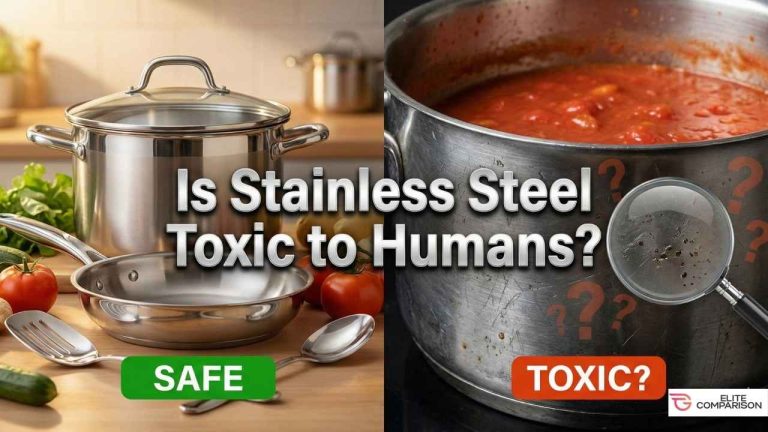
3. The Workhorse: Stainless Steel
No coating to scratch. It takes a little practice to prevent sticking.
- Cooking tip: Heat the pan before adding oil. With practice, stainless will last you decades.
Myths Debunked: One Last Look
To wrap up, let’s put these rumors to bed:
- Myth: “Scratched Teflon gives you cancer.”
Reality: No proven link between eating a few flakes and cancer in humans. The major chemical concern was PFOA, which is not used in modern PTFE coatings. - Myth: “You can repair the coating.”
Reality: Don’t waste money on “fix-it” sprays. Once that polymer bond is broken, it’s gone. - Myth: “Birds dying prove it’s toxic.”
Reality: Birds have very sensitive lungs. They respond to fumes from overheated pans, not to scratches. If you aren’t burning your pan, you’re safe.
The Bottom Line
Is Teflon toxic when scratched? In the way most people think—no. Swallowing a tiny flake won’t poison you. A single scratch is not a medical emergency.
However, a scratched pan is a degrading pan. It can trap bacteria, might leach a little aluminum with acidic foods, and it will eventually lose its nonstick property. My rule of thumb? If it’s flaking into your food or your eggs stick, it’s done its job. Let it go.
You’ll enjoy cooking more on a fresh surface—whether that’s a new $20 nonstick or a heavy-duty cast iron skillet that will outlive us all.