How Good Is Scanpan Cookware: Is It Worth Buying?

Introduction
Scanpan cookware is a strong choice for many U.S. home cooks who want easy-release nonstick pans with sturdy construction. Its best lines offer thick aluminum bodies, induction-ready options, oven-safe designs, and nonstick surfaces that Scanpan says are free of PFOA.
Still, Scanpan is not perfect. It costs more than many nonstick brands, its coating can wear over time, and “metal-utensil safe” does not mean scratch-proof. The best choice depends on your cooktop, cooking style, care habits, and view of PTFE-based nonstick coatings.
Short answer: Scanpan cookware is good to very good for low-stick cooking, even heat, and daily use. It is less appealing if you want uncoated stainless steel, very high-heat searing, or the longest possible service life.

What Is Scanpan Cookware?
Scanpan is a Danish cookware brand sold in the United States through its own website and other retailers. The company makes several cookware families, including Classic, Professional, CTX, HAPTIQ, and other regional or specialty lines.
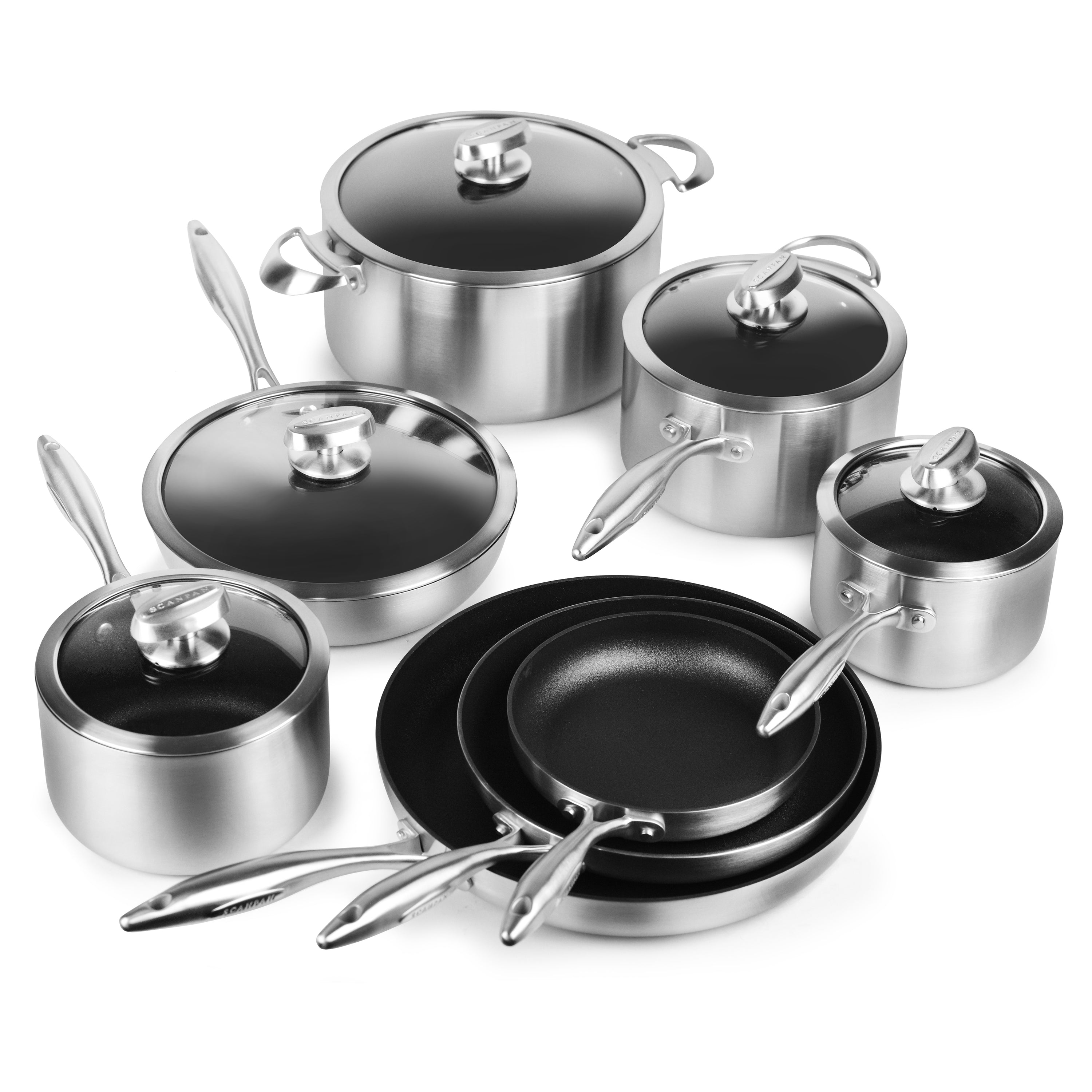
Most Scanpan nonstick pans use an aluminum body with a bonded, textured nonstick coating. Some models have stainless steel exteriors or clad construction. Many are designed for electric, gas, glass, and induction cooktops, but compatibility varies by line.
Scanpan cookware usually falls into three groups:
- Nonstick frying pans and sauté pans: Designed for eggs, fish, pancakes, vegetables, and other foods that can stick.
- Saucepans and stockpots: Used for sauces, grains, soups, and general cooking.
- Stainless steel or mixed-material pieces: Better suited to browning, deglazing, and high-heat cooking.
The main Scanpan feature is its proprietary nonstick surface. Depending on the product line, Scanpan calls this coating Stratanium, Stratanium+, or a related version. The exact structure and performance can vary by model.
How Well Does Scanpan Cook?
Scanpan cookware generally cooks well because its aluminum body spreads heat quickly and its nonstick surface releases food with little oil.
That design helps with foods such as:
- Eggs and omelets
- Fish fillets
- Crepes and pancakes
- Grilled cheese sandwiches
- Delicate vegetables
- Chicken breasts
- Reduced-fat meals
The pan’s shape also matters. A wide cooking surface gives food more room to brown. A sloped side helps with tossing and turning food. A tall side holds more liquid but may reduce the usable frying area.
Heat distribution
Aluminum heats faster than cast iron or thick stainless steel. This can make Scanpan responsive on electric and gas stoves. It also means the pan can become too hot if left empty over high heat.
For even cooking:
- Set the pan over low or medium heat.
- Let it warm for a short time.
- Add oil or food before the pan gets very hot.
- Lower the heat if food browns too fast.
A thick base can reduce hot spots, but no stovetop pan spreads heat perfectly. Small burners, oversized burners, and uneven induction zones can still affect results.
Food release
A new Scanpan nonstick pan should release food easily when used at moderate heat. You may need little oil for eggs or fish, but “nonstick” does not mean “no oil ever.” A small amount of fat can improve browning and reduce residue.
Food may stick when:
- The pan is overheated.
- The surface has a baked-on film.
- The pan is used under a broiler when the manual does not allow it.
- Food is moved before it has formed a crust.
- The coating has become worn.
- A sugar-rich sauce has caramelized on the surface.
Our analysis: Scanpan’s main advantage is control and convenience, not extreme heat performance. It is designed to make routine cooking easier, not to replace a carbon-steel or stainless-steel searing pan.

Is Scanpan Durable?
Scanpan is more durable than many low-cost nonstick pans, but no coated pan lasts forever.
The company markets its Stratanium coatings as highly durable and suitable for metal utensils. That is a documented product claim, not proof that the surface cannot be damaged. A sharp spatula edge, abrasive scrubber, dropped pan, or repeated high-heat use can still shorten its life.
The aluminum body is usually lighter and easier to handle than cast iron. However, aluminum can dent if a pan is dropped or struck against a hard surface. Stainless steel handles and bonded bases may remain functional even after cosmetic wear develops.
What affects the useful life?
The largest factors are:
- Cooking temperature
- Cleaning method
- Utensil shape
- Storage
- Burner size
- Whether the pan is stacked
- How often the pan is used
- Whether cooking sprays leave residue
Cooking spray deserves special attention. Aerosol sprays may contain ingredients that form a sticky layer when heated. That layer can make a good nonstick pan seem less effective.
To protect the surface:
- Use silicone, wood, nylon, or smooth metal tools.
- Avoid cutting food inside the pan.
- Do not stack pans without protection.
- Remove burnt residue with soaking rather than harsh scrubbing.
- Follow the care instructions for your exact model.
Scanpan says many of its pans are dishwasher safe. However, hand washing is usually gentler. Dishwasher detergent, heat, and repeated water exposure can dull the exterior and may reduce the working life of a nonstick coating.
Is Scanpan Safe?
Scanpan’s nonstick cookware is generally intended for normal household cooking when used according to the manufacturer’s instructions. The key safety issue is heat control.
Many Scanpan products use a PTFE-based nonstick coating. Scanpan states that its coatings are made without PFOA. These terms are not identical:
- PFOA is a specific chemical that has been phased out of many consumer applications.
- PTFE is the fluoropolymer commonly used in many nonstick coatings.
- PFAS is a broad chemical family that includes both PFOA and PTFE.
Therefore, “PFOA-free” does not mean “free of all fluorinated materials.” Buyers who want cookware without PTFE or other fluoropolymer coatings should choose uncoated stainless steel, cast iron, carbon steel, or ceramic-coated products after checking the exact materials.
Avoid overheating an empty pan
PTFE coatings can break down at very high temperatures. The risk rises when a coated pan is heated empty, especially over a powerful burner.
Safer practice is simple:
- Do not preheat a nonstick pan empty for a long time.
- Use low to medium heat for most cooking.
- Keep the pan away from direct broiler heat unless the manual permits it.
- Ventilate the kitchen during cooking.
- Follow the temperature limit listed for the exact model.
Bird owners should take extra care. Fumes from severely overheated PTFE cookware can be dangerous or fatal to birds. Keep birds away from the kitchen and avoid overheating any PTFE-coated pan.
What if the coating is scratched?
A small surface mark does not automatically mean the pan is unsafe. However, a badly peeling, flaking, or damaged pan is harder to clean and no longer performs as intended.
Replace the pan if:
- The coating is visibly peeling.
- Large areas have worn away.
- The pan has warped.
- The handle is loose.
- The base no longer sits flat.
- Food sticks across much of the surface despite proper care.
Do not scrape off flakes or keep using a pan solely because the brand claims it is durable.
Is Scanpan Oven-Safe and Induction-Compatible?
Many Scanpan pans are oven-safe, and several lines work on induction cooktops. But these features are not universal across the entire brand.
The safe oven temperature may depend on:
- The pan body
- The handle material
- The lid
- The coating
- The presence of silicone or plastic parts
- The model’s regional instructions
A pan may tolerate a higher oven temperature than its lid or handle. Always check the product page and care manual for the exact model. Do not assume that every Scanpan pan shares the same limit.
For induction cooking, look for an explicit induction-compatible label. An aluminum pan without a magnetic base will not work on induction. A stainless steel exterior does not automatically guarantee induction compatibility either.
If you use a glass-top stove, lift the pan rather than sliding it. This reduces the risk of scratching the cooktop and prevents unnecessary wear on the pan base.
How Does Scanpan Compare With Other Cookware?
Scanpan is strongest when you value easy food release and solid construction but do not want a very heavy pan.
| Cookware type | Main advantage | Main limit | Best use |
|---|---|---|---|
| Scanpan nonstick | Easy release and simple cleanup | Coating can wear | Eggs, fish, daily meals |
| Budget nonstick | Low purchase cost | Often shorter service life | Occasional cooking |
| Stainless steel | Durable and uncoated | Food can stick | Browning, sauces, high heat |
| Cast iron | Excellent heat retention | Heavy and needs care | Searing, baking, frying |
| Carbon steel | Strong searing and improving release | Needs seasoning | High-heat cooking |
| Ceramic-coated nonstick | Often marketed as PFAS-free | Release may decline sooner | Low-to-medium heat cooking |
Scanpan versus stainless steel
Scanpan is easier for eggs and delicate foods. Stainless steel is better for fond, pan sauces, and high-heat browning. Many kitchens benefit from owning both rather than expecting one pan to do every job.
Scanpan versus cast iron
Scanpan is lighter, faster to heat, and simpler to clean. Cast iron holds heat better and can last for decades with proper care. Cast iron is usually the better tool for hard searing, while Scanpan is more convenient for quick meals.
Scanpan versus ceramic nonstick
Ceramic coatings are often chosen by shoppers who want to avoid PTFE. They can release food well when new, but performance may decline with high heat and repeated use. Scanpan may offer a longer useful coating life than some ceramic pans, but the comparison depends on the exact products and care.

Which Scanpan Line Should You Choose?
The best Scanpan line depends on the feature you value most. Product names and specifications can change, so confirm the current U.S. listing before buying.
Choose Classic for practical everyday use
Classic is generally aimed at routine cooking and may offer a simpler design at a lower price than premium lines. It can fit shoppers who want Scanpan’s basic nonstick approach without paying for the most elaborate construction.
Check whether the exact Classic model is induction-compatible and confirm its oven limit.
Choose Professional for a commercial-style design
Professional cookware typically emphasizes stainless steel handles and a more traditional kitchen look. It may suit cooks who want cookware that can move from stovetop to oven, within the stated limits.
Its metal construction can become hot, so use care with handles.
Choose CTX for clad construction and induction use
CTX is known for a stainless steel exterior and compatibility with induction on applicable models. It may appeal to cooks who want the look and feel of stainless steel with a nonstick cooking surface.
The trade-off is weight and cost. A clad pan can feel more substantial than a basic aluminum pan.
Choose HAPTIQ for a premium nonstick option
HAPTIQ is positioned as a higher-end Scanpan line with a polished finish and advanced nonstick construction. It may make sense for frequent cooks who want premium fit and finish.
A higher price does not remove the normal limits of nonstick cookware. It still needs moderate heat and careful handling.
How to Care for Scanpan Cookware
Good care can extend the useful life of a Scanpan pan, although it cannot make a coating permanent.
Daily care routine
- Let the pan cool before washing it.
- Wash with warm water and mild dish soap.
- Use a soft sponge or cloth.
- Remove residue by soaking rather than scraping.
- Dry the pan before storing it.
- Add a pan protector if stacking is necessary.
Do not pour cold water into a very hot pan. Rapid temperature change can stress the material and may contribute to warping.
Can you use metal utensils?
Scanpan states that many of its nonstick surfaces are metal-utensil safe. Smooth, rounded metal tools are less risky than sharp-edged tools. Avoid forks, knives, damaged spatulas, and aggressive scraping.
Metal-safe does not mean metal-preferred. Silicone and wood tools provide a larger safety margin.
Can you put Scanpan in the dishwasher?
Some Scanpan products are labeled dishwasher safe. Use the exact care instructions for your model. Even when dishwasher use is allowed, hand washing is the gentler choice for long-term appearance and coating life.
Do not use scouring powder, steel wool, or abrasive pads unless the manufacturer specifically permits them for the affected surface.

Common Scanpan Problems and Solutions
Food starts sticking
First, check heat. Nonstick pans often perform worse when overheated. Next, clean away invisible grease buildup from cooking spray or oil.
Try this sequence:
- Wash the pan with mild soap and a soft sponge.
- Remove all residue.
- Cook at low or medium heat.
- Add a small amount of oil.
- Replace the pan if sticking remains widespread.
The pan is smoking
Turn off the burner and move the pan away from the heat if safe to do so. Open ventilation. Do not add water to a smoking pan.
Smoking can result from excess oil, an overheated empty pan, or residue on the surface. Let the pan cool before cleaning it.
The pan warps
Warping can follow high heat, rapid cooling, an impact, or use on a burner that is much larger than the pan base. A warped pan may rock on the cooktop and heat unevenly.
Do not try to hammer it flat. Replace it if it no longer sits securely.
The outside becomes discolored
Heat stains and discoloration are often cosmetic. Stainless steel cleaners may work on compatible exterior surfaces, but keep cleaners away from the nonstick cooking surface unless the instructions allow them.
The handle becomes loose
Stop using the pan until the handle is secure. Tighten it only if the manual provides a safe method. If the handle is riveted or damaged, contact Scanpan or the retailer about service or replacement.
Scanpan Pros and Cons
Advantages
- Good food release when new and properly used
- Even heating from aluminum construction
- Several induction-ready options
- Many oven-safe designs
- More robust construction than many inexpensive nonstick pans
- Easy cleanup
- Some models support metal utensils
- PFOA-free claims from the manufacturer
Disadvantages
- Higher price than basic nonstick cookware
- Coating will eventually wear
- PTFE-based models may not suit shoppers avoiding fluoropolymers
- Exact oven and induction limits vary by model
- Heavy use of high heat can reduce coating life
- Dishwasher use may shorten cosmetic and functional life
- Warranty coverage may exclude normal coating wear
Key Takeaways
- Scanpan is good cookware for low- and medium-heat everyday meals.
- Its main strengths are food release, easy cleanup, and solid construction.
- It is not the best tool for repeated high-heat searing.
- Check the exact model for induction, oven, lid, and dishwasher limits.
- PFOA-free does not mean PTFE-free or PFAS-free.
- Use moderate heat and gentle care to extend the coating’s life.
- Buy Scanpan if convenience matters more than owning a fully uncoated pan.
Frequently Asked Questions
Is Scanpan worth the money?
Scanpan can be worth the money if you cook often and want a sturdier nonstick pan than many low-cost options. The value is weaker if you use high heat, replace pans frequently, or prefer uncoated cookware.
How long does Scanpan cookware last?
There is no single life span for every model. Use, heat, cleaning, and storage matter more than the brand name alone. With moderate heat and careful cleaning, a Scanpan pan may remain useful for years, but its nonstick performance will eventually decline.
Is Scanpan better than Teflon?
“Scanpan” is a brand, while “Teflon” is a brand name associated with PTFE coatings. The useful comparison is between the exact pan construction, coating, price, and warranty. Scanpan may have a more robust build than some budget PTFE pans, but both types of coating require heat control.
Does Scanpan contain PFAS?
Many Scanpan nonstick products use PTFE-based coatings. PTFE belongs to the broad PFAS chemical family. Scanpan’s claim that its products are PFOA-free does not establish that they contain no PFAS-related fluoropolymer materials.
Can Scanpan go in the oven?
Many models can go in the oven, but the maximum temperature varies. Check the exact product instructions, including separate limits for the lid and handle. Never assume that every Scanpan line has the same oven rating.
Should you buy Scanpan or stainless steel?
Choose Scanpan for easy release and quick cleanup. Choose stainless steel for high-heat browning, pan sauces, and a cooking surface without a nonstick coating. A mixed cookware set often provides more flexibility than choosing only one type.
Final Verdict: How Good Is Scanpan Cookware?
Scanpan cookware is a good, well-built nonstick option for U.S. kitchens. It can make eggs, fish, pancakes, and other delicate foods easier to cook while offering better construction than many inexpensive pans.
Its limits are clear: the coating is not permanent, high heat is a poor match, and PFOA-free does not mean fluoropolymer-free. For most home cooks who want convenient nonstick performance and are willing to follow care instructions, Scanpan is a sensible purchase. For heavy searing or a pan intended to last for decades, pair it with stainless steel, cast iron, or carbon steel.
Before buying, check three details on the exact U.S. model: induction compatibility, oven temperature limit, and coating material. Those details will determine whether the pan fits your kitchen better than its brand reputation alone.
Sources used for product and safety context
- Scanpan U.S. official cookware information
- U.S. Food and Drug Administration: Authorized uses of food-contact substances
- U.S. Environmental Protection Agency: Per- and polyfluoroalkyl substances
- American Veterinary Medical Association: Household hazards and birds
Conclusion
Scanpan is best viewed as premium everyday nonstick cookware, not as an all-purpose replacement for stainless steel or cast iron. It offers easy cooking and strong convenience, but its performance depends on moderate heat, correct cleaning, and realistic expectations about coating life.
If those trade-offs fit your habits, Scanpan is a good buy. If you want maximum heat tolerance or a coating-free surface, choose another pan type instead.