Can You Put NuWave Cookware in the Oven: Is It Safe?

In most U.S. kitchens, some NuWave cookware can go in the oven, but the answer depends on the exact pan, lid, handle, and model instructions. Many NuWave cookware pieces are made for oven use at a stated temperature, while some lids, knobs, or removable parts have lower limits.
Before placing a NuWave pan in a hot oven, check the label, box, product page, or owner’s manual for:
- The maximum oven temperature
- Whether the lid is oven-safe
- Whether the handle can stay attached
- Whether broiler use is allowed
- Whether the cookware must be placed in a cold oven
If you cannot confirm the rating, do not put the cookware in the oven. A pan may look like an oven-safe skillet but still have a handle, coating, or lid that cannot tolerate high heat.

Quick Answer: Is NuWave Cookware Oven-Safe?
Many NuWave cookware products are oven-safe, often up to a stated limit such as 500°F, but not every NuWave item has the same rating. The exact model instructions control.
Do not assume that every product sold by NuWave has the same oven rating. NuWave sells cookware, induction products, air fryers, pressure cookers, and other kitchen appliances. An accessory made for a NuWave appliance is not automatically safe for a conventional oven.
The safest rule is simple:
Use NuWave cookware in the oven only when the specific product is marked or documented as oven-safe. Stay below the lowest-rated part.
For example, if the pan is rated to 500°F but the glass lid is rated to 350°F, the covered dish must stay at or below 350°F. If the handle has a lower rating than the pan, remove the handle only if the instructions specifically permit it.

What Determines Whether NuWave Cookware Can Go in the Oven?
The cookware material is only one part of the answer. The weakest component sets the safe limit.
Pan body
A metal pan may tolerate oven heat well, but its coating can have a different limit. NuWave products with ceramic or other nonstick coatings should be used within the temperature range listed by NuWave.
High heat can damage a nonstick surface even when the metal beneath it remains intact. Avoid using a coated pan under a broiler unless the instructions clearly allow broiler use.
Handles
Handles can contain plastic, silicone, rubber, or other heat-sensitive parts. A handle that stays cool on the stovetop may soften, discolor, crack, or become unsafe in an oven.
Some cookware handles are permanently attached. Others may be removable. Never remove or attach a handle while the pan is hot, and do not assume that a detachable handle makes the pan safe at any temperature.
Lids
A lid may have several parts with different heat limits:
- Glass
- Silicone seals
- Plastic knobs
- Metal rims
- Steam vents
A glass lid rated for oven use may still have a knob or seal that limits the temperature. Use the lowest rating shown in the NuWave instructions.
Coating
Nonstick coatings need careful handling. Excessive heat, an empty pan, sudden temperature changes, and metal utensils can shorten the life of the coating.
If the coating is bubbling, peeling, badly scratched, or flaking, stop using the pan. Do not place damaged coated cookware in the oven.
Product design
Some NuWave items are cookware. Others are appliance parts or accessories. A cooking rack, basket, tray, or liner designed for a NuWave air fryer may not be intended for a full-size oven.
Always identify the product before checking its oven rating.

How to Check Your NuWave Cookware’s Oven Rating
Use the product-specific information rather than a general statement about NuWave cookware.
1. Find the model name or number
Look on:
- The bottom of the pan
- The original packaging
- The product label
- The receipt or order record
- The NuWave instruction manual
Write down the exact model name. “NuWave cookware” is not specific enough because different collections may use different materials and parts.
2. Read the owner’s manual
Search the manual for terms such as:
- Oven-safe
- Maximum temperature
- Conventional oven
- Broiler
- Lid
- Handle
- Cookware care
- Thermal shock
The manual may list separate limits for the pan and lid.
3. Inspect the pan and lid
Look for molded, printed, or engraved warnings. A temperature symbol does not always mean that the item is safe at every oven temperature.
Check whether the warning applies to:
- The pan only
- The lid only
- The handle
- The complete assembled cookware set
4. Confirm the oven type
A conventional oven, convection oven, toaster oven, and broiler can expose cookware to different heat patterns.
If the instructions mention a conventional oven but do not mention a toaster oven or broiler, do not treat those uses as automatically approved.
5. Use the lowest temperature limit
Suppose the pan is rated to 500°F, the glass lid to 400°F, and the handle to 350°F. The complete setup should not exceed 350°F.
If the manual gives no clear limit, contact NuWave customer support before using the cookware in the oven.

How to Use NuWave Cookware in the Oven Safely
Once you confirm that the specific item is oven-safe, follow these steps.
Before heating
- Check the maximum temperature. Set the oven below the lowest listed limit.
- Inspect the cookware. Do not use pieces with cracks, loose handles, peeling coating, or damaged glass.
- Remove parts that are not oven-safe. Remove a lid, knob, or handle only when the manufacturer’s instructions allow it.
- Use oven mitts. The handle may become hot even if it stays cool on the stovetop.
- Place the pan on a stable rack. Keep it away from the heating element and oven wall.
- Avoid an empty high-heat preheat. Nonstick cookware can suffer damage when heated without food or liquid.
During cooking
- Keep the pan below its stated temperature limit.
- Do not use a broiler setting unless NuWave approves it.
- Do not place a hot pan on a wet, cold, or highly polished surface.
- Do not add cold liquid to a very hot pan.
- Keep children away from the oven and cookware handles.
- Use both hands for large or heavy pans.
After cooking
- Remove the pan with dry, heat-resistant mitts.
- Set it on a heat-safe trivet or wooden surface.
- Let it cool before washing.
- Avoid pouring cold water into hot cookware.
- Follow the manufacturer’s cleaning instructions.
Sudden temperature changes can stress glass lids and metal cookware. A cracked lid may fail without much warning.
Can the NuWave Lid Go in the Oven?
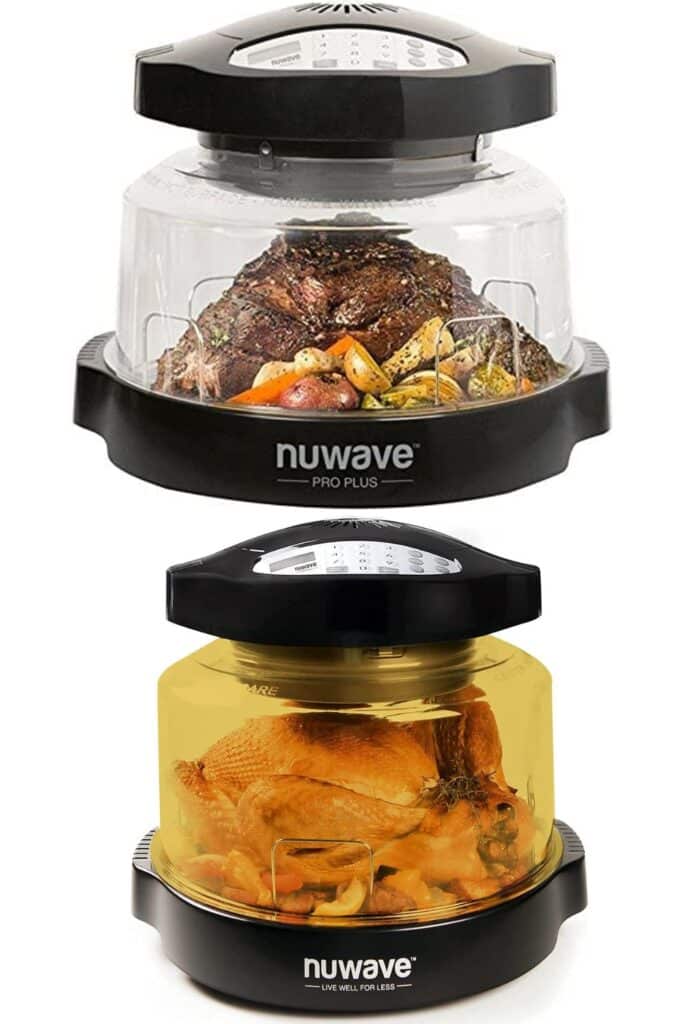
A NuWave lid can go in the oven only if the lid and every part attached to it are rated for that use.
A lid’s glass may tolerate oven heat while its knob, seal, or vent does not. If the instructions give separate limits, follow the lowest one.
Do not use a lid in the oven if:
- The manual says “stovetop only”
- The knob contains plastic that is not oven-rated
- The lid has a damaged seal
- The glass is chipped or cracked
- The temperature rating is missing
- The lid is not made for that cookware model
Never move a hot glass lid from the oven directly onto a wet countertop. Use a dry, heat-safe surface and allow it to cool gradually.
If you are unsure about the lid, cook with the pan uncovered or use a separate oven-safe cover that is clearly rated for the temperature.

Can You Put NuWave Cookware Under the Broiler?
Do not place NuWave cookware under a broiler unless the product instructions specifically say that broiler use is allowed.
A broiler exposes the cookware to intense, direct heat. This is different from ordinary baking, where hot air surrounds the pan more evenly.
Broiling can damage:
- Nonstick coatings
- Silicone parts
- Plastic handles
- Glass lids
- Exterior finishes
- Seals and vents
Even if the cookware is oven-safe to 500°F, that does not automatically make it broiler-safe. A broiler may create concentrated heat well above the temperature measured in the oven cavity.
For browning or melting cheese, use a normal oven setting unless the NuWave instructions approve the broiler setting.

Can NuWave Cookware Go From the Stovetop to the Oven?
It may be able to move from the stovetop to the oven if the entire cookware setup is oven-rated and the temperature change is reasonable.
This is a common use for oven-safe skillets. Still, several limits apply:
- Do not move cookware from a very high burner directly into a very hot oven unless the instructions allow it.
- Do not transfer a hot pan onto a cold stone, wet counter, or glass surface.
- Do not place a cold glass lid on a hot pan.
- Do not add cold water to hot coated cookware.
- Use care with induction, electric, and gas burners because they heat cookware differently.
A pan can survive the oven temperature yet fail from thermal shock. Gradual heating and cooling are safer for coated metal and glass components.
What Temperature Should You Use?
Use the manufacturer’s limit as the upper boundary, not as a target.
| Part or condition | Safe approach |
|---|---|
| Pan only | Stay below the pan’s documented maximum |
| Pan with lid | Follow the lid’s lower rating |
| Pan with attached handle | Follow the handle’s lower rating |
| Nonstick coating | Use moderate heat and avoid empty preheating |
| Broiler setting | Use only when specifically approved |
| Unknown rating | Do not use it in the oven until confirmed |
| Damaged cookware | Replace it rather than testing it |
For example, if a NuWave pan is documented as oven-safe to 500°F but its lid is limited to 350°F, use the covered dish at 350°F or less. The rating is not an invitation to cook at the maximum temperature every time.

Common Mistakes to Avoid
Assuming all NuWave products have the same rating
NuWave product lines can differ in materials, handles, lids, and intended use. Check the exact model.
Treating “oven-safe” as “broiler-safe”
These terms are not interchangeable. Direct broiler heat is more severe than standard baking.
Forgetting the lid handle
The glass may be oven-safe while the knob is not. Check the full lid assembly.
Using high heat with an empty nonstick pan
An empty pan can heat rapidly and damage its coating. Add food or liquid when appropriate, and avoid unnecessary high heat.
Putting a hot pan on a cold surface
Rapid temperature changes can cause warping or glass breakage.
Using a damaged pan
A scratched or peeling coating may worsen in the oven. Replace cookware that shows serious damage.
Using an appliance accessory in a conventional oven
A NuWave air fryer basket, tray, rack, or liner may have a separate design and temperature limit. Follow the accessory instructions, not the cookware instructions.

What to Do If You Cannot Find the Instructions
If you cannot locate the manual or product rating, use this order:
- Stop and identify the model.
- Search the official NuWave product support pages by model name or number.
- Check the original retailer listing, but treat it as secondary to the manufacturer’s manual.
- Contact NuWave customer support with a photo and model number.
- Do not test the cookware by placing it in a hot oven.
Do not rely only on appearance, brand name, or another NuWave product with a similar design. A missing temperature rating is a reason to verify the product, not a reason to guess.

Key Takeaways
- Many NuWave cookware pieces may be oven-safe, but the rating is model-specific.
- The pan, handle, lid, knob, and coating may have different limits.
- Use the lowest temperature rating for the complete setup.
- Oven-safe does not automatically mean broiler-safe.
- Do not use damaged cookware or unknown accessories in the oven.
- Check the official NuWave manual before cooking.
Frequently Asked Questions
Can I put a NuWave ceramic pan in the oven?
You can do so only if the specific NuWave ceramic pan is documented as oven-safe. Check the model instructions for the pan, handle, lid, and maximum temperature. Ceramic nonstick cookware should not be treated as broiler-safe unless the manufacturer says so.
Can I put a NuWave frying pan in a 400°F oven?
Only if that exact frying pan and its attached parts are rated above 400°F. If the handle or lid has a lower limit, use the lower limit instead. If no rating is available, do not use the pan at 400°F.
Can I put a NuWave glass lid in the oven?
Some NuWave glass lids may be oven-safe, but the answer depends on the lid design and its knob, rim, seal, and vent. Check the lid’s instructions. Never use a cracked or chipped glass lid.
Can I use NuWave cookware on an induction stove and then in the oven?
Induction compatibility does not prove oven safety. It only shows that the cookware can work with an induction cooking surface. Confirm the oven rating separately.
How do I know if my NuWave cookware is damaged from oven use?
Look for peeling or blistered coating, discoloration, warping, loose handles, cracked glass, or a damaged seal. Stop using the item if you see serious damage, especially if the coating is flaking or the handle is no longer secure.
Conclusion
Yes, some NuWave cookware can go in the oven, but you must verify the exact model and the rating of every part you plan to use. Keep the oven below the lowest documented limit, avoid broiling unless approved, and handle hot cookware with dry oven mitts.
The safest next step is to find the model number and read the matching NuWave manual before preheating the oven.