Can Viking Cookware Go in the Oven: Oven Safety Guide

Yes, most Viking cookware can go in the oven, but the safe temperature depends on the exact collection, coating, lid, and handle. Many Viking stainless-steel pans are oven-safe to high temperatures. Viking nonstick cookware often has a lower limit, while glass lids and removable parts may have separate limits.
For U.S. kitchens, always check the temperature printed in the product manual or on Viking’s official product page before using a pan in an oven or under a broiler. If you cannot confirm the limit, use a conservative temperature and avoid broiling.

Is Viking cookware oven-safe?
Most Viking cookware is designed for oven use, but “Viking cookware” covers several materials and product lines. A stainless-steel skillet, a nonstick fry pan, and a covered Dutch oven may not share the same heat limit.
Viking’s U.S. cookware range includes products made from:
- Stainless steel
- Aluminum with nonstick coatings
- Enameled cast iron
- Cast iron
- Glass and stainless-steel lids
- Multi-layer, or clad, metal construction
The main pan body may tolerate more heat than the lid, coating, handle, or knob. The lowest-rated part controls the safe temperature for the complete pan.
Typical Viking oven temperature limits
The following ranges are useful as a guide, not a replacement for the instructions for your model.
| Viking cookware part or type | Common oven-use guidance | Main caution |
|---|---|---|
| Stainless-steel cookware | Often up to about 600°F | Handle and lid limits may differ |
| Viking nonstick cookware | Often up to about 500°F | Coating and handle materials set the limit |
| Glass lids | Often lower than the pan | Sudden temperature changes may crack glass |
| Enameled cast iron | Usually suitable for oven cooking | Avoid thermal shock and high broiler heat unless approved |
| Removable silicone or plastic parts | Varies by part | Remove them if the manual requires it |
| Any cookware under a broiler | Model-specific | Broiler heat is intense and may exceed normal oven ratings |
These figures reflect common manufacturer specifications for Viking product families. Viking has changed collections over time, so the name “Viking” alone does not establish one universal temperature limit.
How to find the oven limit for your Viking pan
The safest method is to identify the exact product and check its current instructions.
-
Look at the bottom of the pan.
Search for a model name, collection name, size, or item number. -
Check the handle and lid.
A metal pan may be oven-safe while a lid knob, silicone grip, or glass lid has a lower rating. -
Read the care guide.
Look for terms such as “oven-safe,” “maximum oven temperature,” and “broiler-safe.” -
Use the lower limit.
If the pan is rated to 600°F but the lid is rated to 400°F, keep the covered pan at or below 400°F. -
Remove unapproved parts.
Take off silicone sleeves, plastic accessories, or removable handles if Viking does not list them as oven-safe. -
Confirm the temperature in Fahrenheit.
Viking’s U.S. instructions normally use Fahrenheit. Do not assume that a rating for one market or collection applies to a U.S. model with the same name.
If the model number is missing, contact Viking customer support or the retailer that sold the cookware. A product photo may help, but it may not show the materials used in the handle or lid.
Can Viking stainless-steel cookware go in the oven?
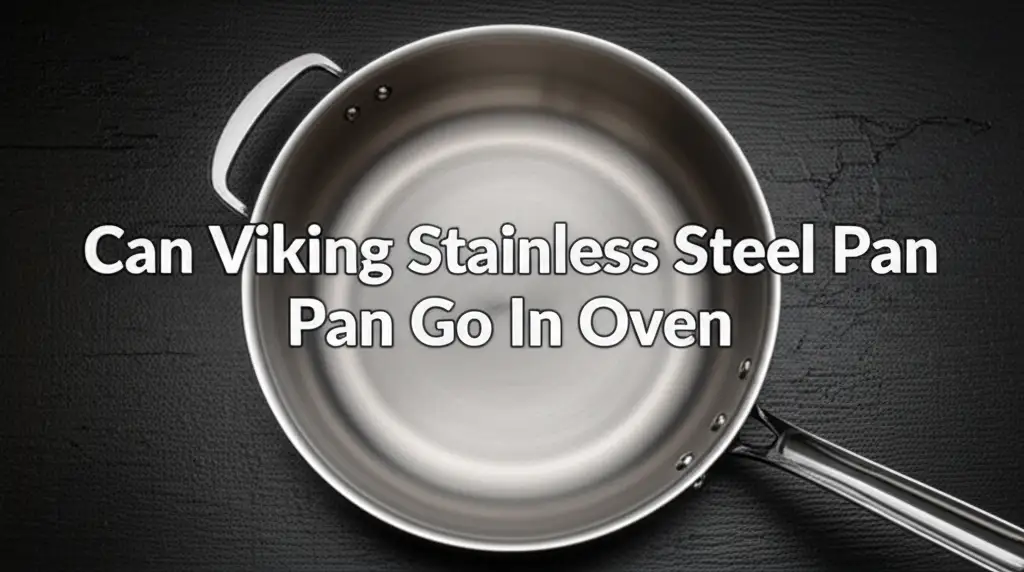
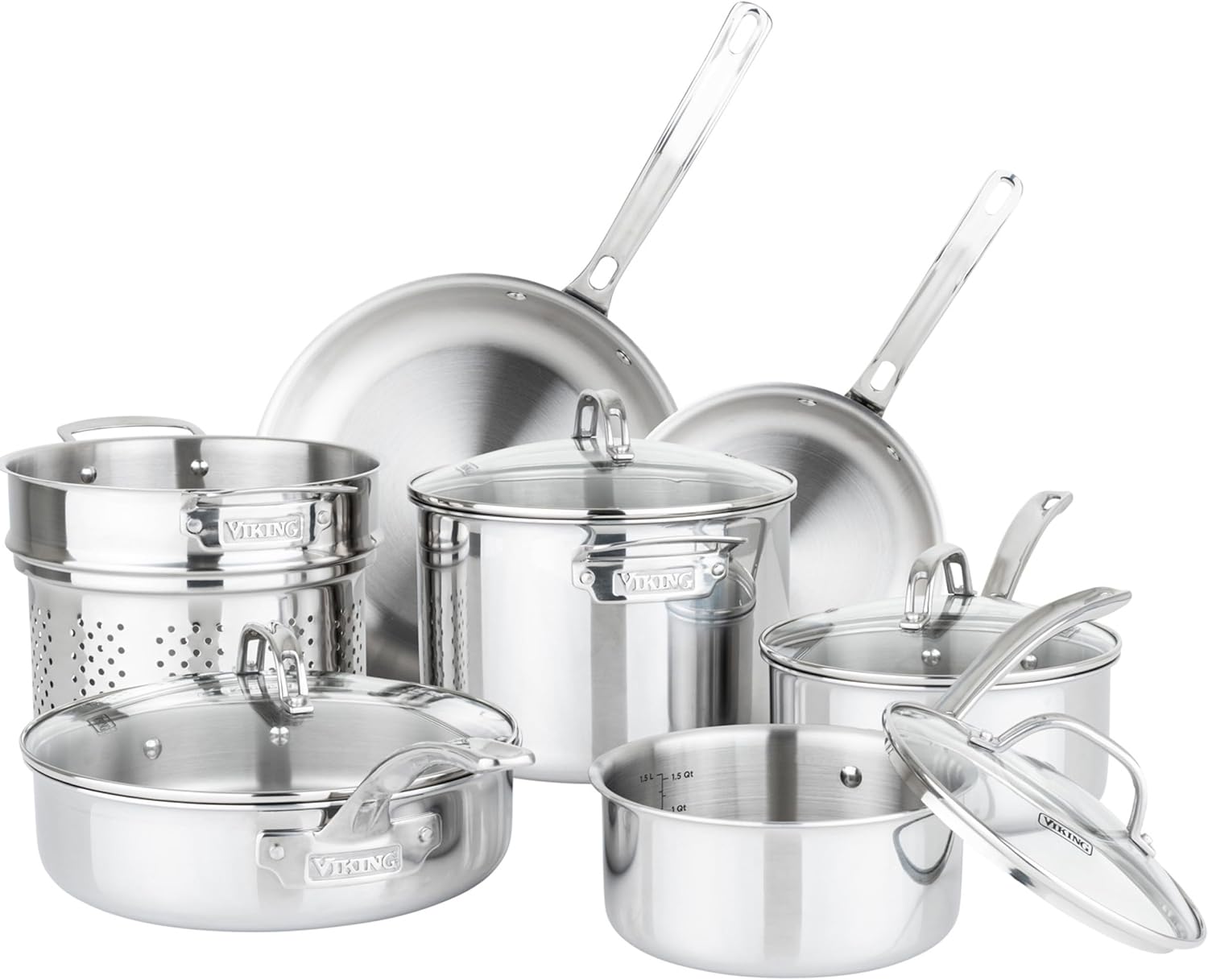
Viking stainless-steel cookware is generally well suited to oven use. Many Viking stainless-steel and multi-ply pans are built for high-heat cooking and can move from the stovetop to the oven.
A stainless-steel pan is often a good choice for:
- Finishing a thick steak
- Baking a frittata
- Roasting vegetables
- Browning meat before braising
- Making pan sauces
- Baking cornbread or other skillet dishes
Still, inspect the full pan. Stainless steel does not mean every attached part is made of stainless steel. Handles may include other metals, and lids may contain glass or a heat-sensitive knob.
Stainless-steel pan safety
Use oven mitts when removing the pan. The handle can become hot even if it stayed cool on the stovetop.
Do not place a hot stainless-steel pan on a wet counter or cold stone surface. A sudden temperature change can warp the pan or damage the surface beneath it. Set it on a dry, heat-resistant trivet instead.
Do not assume that a high oven rating makes a pan safe under the broiler. Direct broiler heat can be much harsher than normal baking heat. Use the broiler only when Viking specifically allows it.
Can Viking nonstick cookware go in the oven?
Many Viking nonstick pans can go in the oven, but their temperature limit is usually lower than that of uncoated stainless steel. The nonstick surface, handle, and exterior finish all matter.
Viking nonstick cookware may be useful for:
- Oven-finishing eggs or a frittata
- Cooking fish
- Baking a small skillet dish
- Browning food on the stove before gentle oven cooking
Avoid very high heat unless the instructions clearly permit it. Excessive heat can shorten the life of a nonstick coating, discolor the pan, or damage a handle. Never preheat an empty nonstick pan at high heat for a long period.
Can Viking nonstick cookware go under the broiler?
Do not place Viking nonstick cookware under a broiler unless the exact care guide says it is broiler-safe. An oven-safe rating does not automatically include broiler use.
A broiler exposes the pan to direct radiant heat from above. That heat can exceed the normal conditions used for baking. It may damage the coating or any heat-sensitive part of the pan.
For a browned top, transfer the food to a broiler-safe baking dish when the cookware instructions are unclear.
:max_bytes(150000):strip_icc()/faw-product-kitchenaid-hard-anodized-induction-10-piece-nonstick-cookware-set-14-wdickey-267-9b89ff5018cb4aca8cc6fa57ed6fd878.jpeg "Can Viking stainless-steel cookware go in the oven?")
Can Viking cookware with glass lids go in the oven?
A Viking glass lid may be oven-safe, but its limit can be lower than the pan’s limit. The lid may also have a stainless-steel rim, metal handle, or knob made from another material.
Before using a glass lid in the oven:
- Check the lid’s maximum temperature.
- Avoid placing a cold lid into a hot oven.
- Do not move a hot lid directly onto a cold or wet surface.
- Do not pour cold liquid onto a hot lid.
- Inspect the glass for chips, cracks, or deep scratches.
- Do not use a damaged lid.
Glass can break from thermal shock even when its listed oven temperature has not been exceeded. Let the lid warm with the pan when possible, and keep temperature changes gradual.
If the pan is rated to 600°F but its glass lid is rated to 400°F, use the covered pan at 400°F or below.
Can Viking cookware go from the freezer or refrigerator to the oven?
Do not move cold Viking cookware or a cold glass lid directly into a hot oven unless the product instructions clearly allow it. The sudden change can cause warping, cracking, or breakage.
This matters most with:
- Glass lids
- Enameled cast iron
- Cast iron
- Ceramic-coated cookware
- Cookware containing cold liquids or frozen food
A safer approach is to let the cookware warm gradually. For a refrigerated casserole or braise, use an oven-safe dish made for that purpose and follow the dish maker’s instructions.
Do not heat a frozen food container simply because the container fits inside the oven. Oven compatibility depends on the material and its stated use, not its shape.
Can Viking cookware go under the broiler?
The answer is sometimes, but not automatically.
Broiling is different from ordinary oven cooking. The heating element is close to the food and may expose the rim, handle, coating, or lid to intense direct heat.
Use these checks:
- Confirm that the exact Viking model is broiler-safe.
- Remove the lid unless the instructions allow broiling with it.
- Keep nonstick cookware away from the broiler unless Viking expressly approves it.
- Keep handles away from the direct heating element.
- Watch the food closely.
- Stop if the coating smokes, blisters, or changes appearance.
If the manual does not mention broiling, treat the pan as not confirmed for broiler use.

Safe oven use: a simple step-by-step method
Use this process each time you move Viking cookware from the stovetop to the oven.
1. Identify the cookware
Find the collection, material, size, and model number. A product name such as “Viking skillet” is not precise enough if several versions exist.
2. Check every removable part
Inspect the lid, knob, handle cover, helper handle, and silicone insert. Remove any part that is not rated for the planned temperature.
3. Choose a temperature below the lowest limit
For example, if the pan is rated to 600°F and the lid to 400°F, set the oven to no more than 400°F.
4. Preheat with care
Do not place a cold glass lid or very cold pan into a fully heated oven unless the instructions allow it. Gradual heating reduces thermal stress.
5. Protect your hands
Use dry, heat-resistant oven mitts. Stovetop handles can become extremely hot in the oven.
6. Use a safe landing spot
Place the hot pan on a dry trivet, wooden board rated for heat, or another suitable surface. Avoid wet towels, cold countertops, and damp sinks.
7. Cool the cookware gradually
Do not fill a hot pan with cold water. Let it cool first, then wash it according to Viking’s care instructions.
A safe result means the pan shows no smoke, coating damage, warping, cracks, or loose parts. If any of these signs appear, stop using the cookware until Viking or a qualified service professional confirms that it is safe.
What happens if Viking cookware is overheated?
Overheating can damage the cookware even when it does not fail at once. The likely result depends on the material.
- Nonstick cookware: The coating may discolor, lose performance, blister, or release smoke.
- Stainless steel: The pan may discolor or warp after severe or uneven heating.
- Glass lids: The glass may crack or shatter from excess heat or thermal shock.
- Enameled cookware: The enamel may chip, craze, or suffer surface damage.
- Handles and knobs: Plastic, silicone, or other heat-sensitive parts may soften or deform.
Turn off the oven if cookware begins to smoke. Ventilate the room, allow the pan to cool, and do not touch it with bare hands. For nonstick cookware that has visibly blistered, peeled, or changed texture, replace it rather than trying to restore the surface.
Viking oven-use mistakes to avoid
The most common mistake is treating the cookware brand as the temperature rating. Viking makes several collections, and each can use different materials and parts.
Avoid these errors:
- Using a pan at the highest possible temperature without checking the manual
- Assuming an oven-safe pan is also broiler-safe
- Leaving a plastic or silicone accessory attached
- Heating an empty nonstick pan for a long time
- Putting cold glass into a hot oven
- Pouring cold water into hot cookware
- Touching an oven-heated handle without protection
- Using cookware with cracked glass, loose handles, or damaged coating
- Placing a hot pan on a wet or cold surface
- Scrubbing nonstick cookware with abrasive tools
These actions can cause injury, damage the cookware, or shorten its useful life.
Viking cookware oven-safety decision table
Use this table for a quick first check. The product manual remains the final authority.
| Your Viking cookware | Oven use | What to verify |
|---|---|---|
| Uncoated stainless-steel pan | Usually suitable | Maximum temperature, handle, lid |
| Stainless-steel pan with a glass lid | Usually suitable with limits | Separate lid rating and thermal-shock guidance |
| Viking nonstick pan | Often suitable at moderate heat | Coating limit and broiler warning |
| Enameled cast-iron pan | Usually suitable | Temperature limit, lid, and gradual heating |
| Pan with a plastic handle or knob | Uncertain without the manual | Material and removable-part rating |
| Pan with a silicone sleeve | Only if listed as oven-safe | Sleeve temperature limit |
| Any Viking pan under a broiler | Do not assume it is safe | Specific broiler approval |
The deciding factor is not only the pan body. The least heat-resistant component sets the safe limit.

Frequently asked questions
Can Viking cookware go in a 400°F oven?
Often, yes, but check the exact product first. Many Viking stainless-steel and nonstick pieces can handle 400°F, yet a lid, handle, or accessory may have a lower limit.
Can I put a Viking frying pan in the oven?
Usually, yes, if the model is oven-rated. Confirm the material and maximum temperature, then use oven mitts because the handle will be hot.
Can I use a Viking nonstick pan at 450°F?
Some Viking nonstick cookware may allow this temperature, but the answer depends on the collection. Check the product instructions before using 450°F, and do not assume the pan is safe under a broiler.
Are Viking pan lids oven-safe?
Many are, but the lid may have a lower temperature rating than the pan. Glass lids also need protection from sudden temperature changes.
How do I know if my old Viking pan is oven-safe?
Look for a model number, collection name, or care label. If you cannot identify the model, contact Viking or the original retailer. Do not rely on the brand name alone.
Can I put Viking cookware in the dishwasher after oven use?
Dishwasher guidance varies by collection. Let the cookware cool first, then follow Viking’s care instructions. Hand washing is often the safer choice for nonstick surfaces and some lids.
Key takeaways
- Most Viking cookware can go in the oven, but the limit varies by model.
- Stainless-steel pans often tolerate higher heat than nonstick pans.
- Glass lids, knobs, silicone parts, and handles may have separate limits.
- Oven-safe does not automatically mean broiler-safe.
- Use the lowest temperature rating among all parts.
- Avoid sudden temperature changes.
- Check the exact Viking manual whenever the model or material is unclear.
Conclusion
Viking cookware is often made for stovetop-to-oven cooking, especially its stainless-steel and cast-iron lines. The safe answer depends on the exact pan, coating, lid, and handle—not just the Viking name.
Before using it in a U.S. oven, identify the model, confirm the temperature in Fahrenheit, remove any unapproved parts, and stay below the lowest listed limit. When the instructions are missing, avoid broiling and choose a moderate temperature until Viking confirms the cookware’s rating.